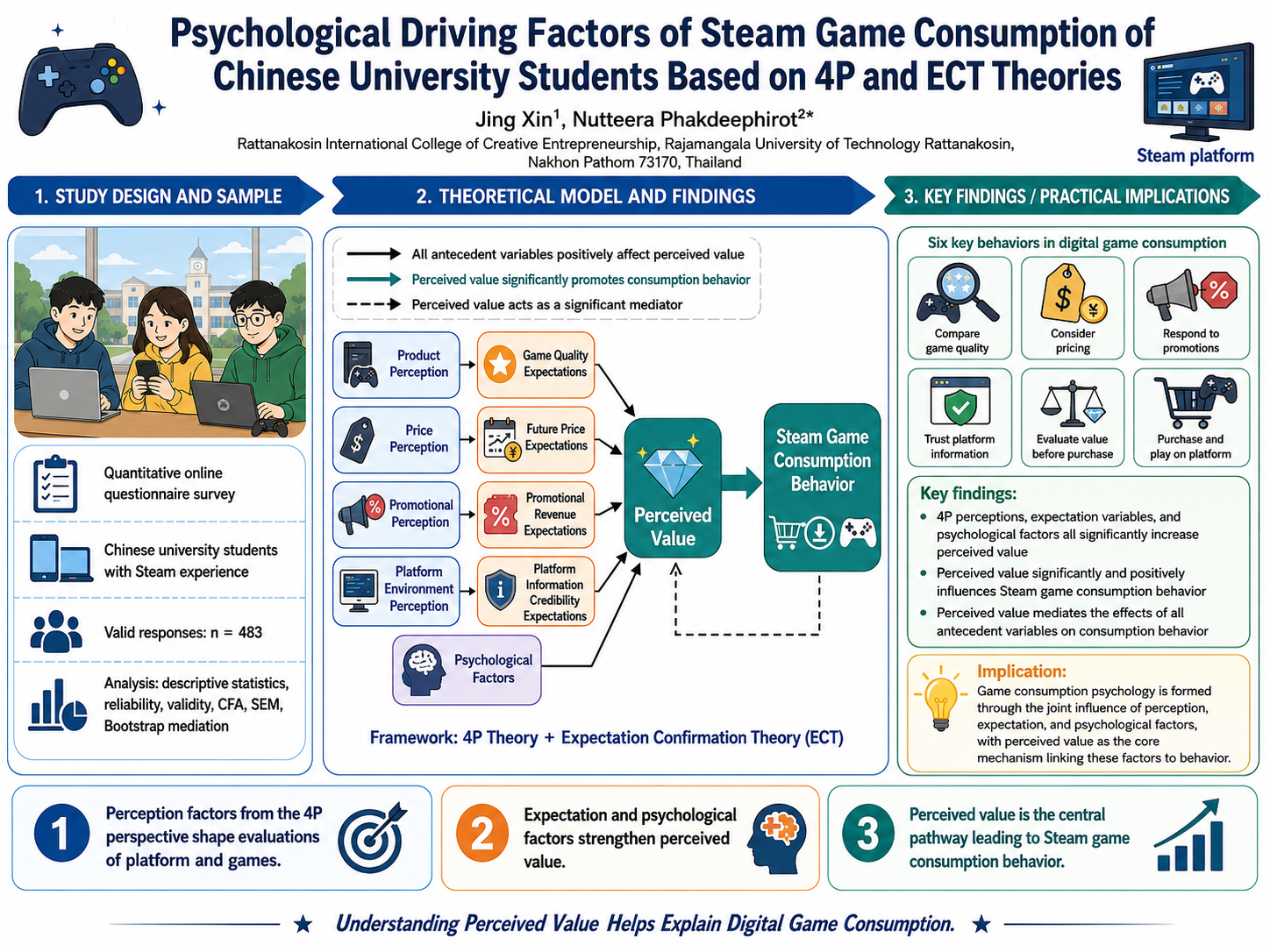
Psychological Driving Factors of Steam Game Consumption of Chinese University Students Based on 4P and ECT Theories
Keywords:
Steam platform; Purchasing psychology; Perceived value; Expectation Confirmation Theory; 4P theory; Consumption behaviorAbstract
With the rapid development of digital game platforms, Steam has become one of the most influential platforms for digital game consumption among Chinese university students. However, limited research has systematically explored the psychological mechanisms underlying their purchasing behavior. Therefore, this study aims to investigate the formation mechanism of purchasing psychology among Chinese university students on the Steam platform by integrating the 4P theory and Expectation Confirmation Theory (ECT). A quantitative research approach was adopted, and data were collected through an online questionnaire survey from 483 Chinese university students with Steam experience. The data were analyzed using descriptive statistics, reliability and validity analysis, confirmatory factor analysis (CFA), structural equation modeling (SEM), and Bootstrap mediation analysis. The results indicate that product perception, price perception, promotional perception, platform environment perception, game quality expectations, future price expectations, promotional revenue expectations, platform information credibility expectations, and psychological factors all have significant positive effects on perceived value. Furthermore, perceived value significantly and positively influences Steam game consumption behavior and serves as a significant mediating variable between all antecedent variables and consumption behavior. These findings demonstrate that purchasing psychology is formed through the joint influence of perception, expectation, and psychological factors, with perceived value acting as the core mechanism linking these factors to consumption behavior.
References
Barros, F., Veiga, R. T., Moura, L. R. C., Urdan, A. T., & de Matos, C. A. (2024). Behavioral consequences of value perception in Steam Community Market users. Brazilian Administration Review, 21, e240131. https://doi.org/10.1590/1807-7692bar2024240131
Bhattacherjee, A. (2001). Understanding information systems continuance: An expectation-confirmation model. MIS Quarterly, 25(3), 351–370. https://doi.org/10.2307/3250921
Blut, M., Chaney, D., Lunardo, R., Mencarelli, R., & Grewal, D. (2024). Customer perceived value: A comprehensive meta-analysis. Journal of Service Research, 27(4), 501–524. https://doi.org/10.1177/10946705231222295
Chan, L., & Idris, N. (2017). Validity and Reliability of The Instrument Using Exploratory Factor Analysis and Cronbachâs alpha. International Journal of Academic Research in Business and Social Sciences, 7(10),3387. https://doi.org/10.6007/IJARBSS/v7-i10/3387
Dillman, D. A., Smyth, J. D., & Christian, L. M. (2014). Internet, phone, mail, and mixed-mode surveys: The tailored design method. Indianapolis, Indiana, 17. https://doi.org/10.1002/9781394260645
Fornell, C., & Larcker, D. F. (1981). Evaluating structural equation models with unobservable variables and measurement error. Journal of Marketing Research, 18(1), 39–50. https://doi.org/10.1177/002224378101800104
Grewal, D., Monroe, K. B., & Krishnan, R. (1998). The effects of price-comparison advertising on buyers’ perceptions of acquisition value, transaction value, and behavioral intentions. Journal of Marketing, 62(2), 46–59.https://doi.org/10.1177/002224299806200204
Hoyle, R. H. (2000). Confirmatory factor analysis. In Handbook of Applied Multivariate Statistics and Mathematical Modeling, 465-497.https://doi.org/10.1016/B978-012691360-6/50017-3
Hu, L.-t., & Bentler, P. M. (1999). Cutoff criteria for fit indexes in covariance structure analysis: Conventional criteria versus new alternatives. Structural Equation Modeling: A Multidisciplinary Journal, 6(1), 1–55. https://doi.org/10.1080/10705519909540118
Hussey, I., Alsalti, T., Bosco, F., Elson, M., & Arslan, R. (2025). An Aberrant Abundance of Cronbach’s Alpha Values at .70. Advances in Methods and Practices in Psychological Science, 8(1),25152459241287123. https://doi.org/10.1177/25152459241287123
Kalyanam, K., & McIntyre, S. (2002). The e-marketing mix: A contribution of the e-tailing wars. Journal of the Academy of Marketing Science, 30(4), 487–499. https://doi.org/10.1177/009207002236924
Lim, L. P., Ong, C. H., Teo, P. C., & Theresa, H. C. F. (2024). Online purchase intention of digital products among university students. Business Management and Strategy, 15(1), 241–255. https://doi.org/10.5296/bms.v15i1.21869
Norman, G. (2010). Likert scales, levels of measurement and the “laws” of statistics. Advances in Health Sciences Education, 15(5), 625–632. https://doi.org/10.1007/s10459-010-9222-y
Oliver, R. L. (1980). A cognitive model of the antecedents and consequences of satisfaction decisions. Journal of Marketing Research, 17(4), 460-469.https://doi.org/10.1177/002224378001700405
Preacher, K. J., & Hayes, A. F. (2008). Asymptotic and resampling strategies for assessing and comparing indirect effects in multiple mediator models. Behavior Research Methods, 40(3), 879–891. https://doi.org/10.3758/BRM.40.3.879
Regmi, P. R., Waithaka, E., Paudyal, A., Simkhada, P., & van Teijlingen, E. (2016). Guide to the design and application of online questionnaire surveys. Nepal Journal Epidemiology, 6(4), 640-644.https://doi.org/10.3126/nje.v6i4.17258
Ryan, R. M., Rigby, C. S., & Przybylski, A. (2006). The motivational pull of video games: A self-determination theory approach. Motivation and Emotion, 30(4), 344–360. https://doi.org/10.1007/s11031-006-9051-8
Sae-tae, K., & Wang, Q. (2024). Satisfied but no payment: The impact of perceived value on continuance intention and purchase intention in music streaming services. Telematics and Informatics Reports, 16, 100179.https://doi.org/10.1016/j.teler.2024.100179
Sullivan, G. M., & Artino, A. R., Jr. (2013). Analyzing and interpreting data from Likert-type scales. Journal of Graduate Medical Education, 5(4), 541–542. https://doi.org/10.4300/JGME-5-4-18
Sweeney, J. C., & Soutar, G. N. (2001). Consumer perceived value: The development of a multiple-item scale. Journal of Retailing, 77(2), 203–220. https://doi.org/10.1016/S0022-4359(01)00041-0
Torrejón-Guirado, M.-C., San Martín-Erice, I., San Martín-Rodríguez, L., & Lima-Serrano, M. (2024). Methodological and strategic insights for online survey studies: An analysis based on the Cherries checklist. Enfermería Clínica (English Edition), 34(3), 207–213.https://doi.org/10.1016/j.enfcle.2024.06.001
Wolf, E. J., Harrington, K. M., Clark, S. L., & Miller, M. W. (2013). Sample Size Requirements for Structural Equation Models: An Evaluation of Power, Bias, and Solution Propriety. Educational Psychological Measurement, 76(6), 913-934. https://doi.org/10.1177/0013164413495237
Wulandari, P. (2022). Structural Equation Modelling (SEM) in Research: Narrative Literature Review. Open Access Indonesia Journal of Social Sciences, 5(6), 852-858.https://doi.org/10.37275/oaijss.v5i6.141
Yao, M., & Xu, Y. (2024). Method bias mechanisms and procedural remedies. Sociological Methods & Research, 53(1), 235–278. https://doi.org/10.1177/00491241211043141
Yee, N. (2006). Motivations for play in online games. CyberPsychology & Behavior, 9(6), 772–775. https://doi.org/10.1089/cpb.2006.9.772
Zeithaml, V. A. (1988). Consumer perceptions of price, quality, and value: A means-end model and synthesis of evidence. Journal of Marketing, 52(3), 2–22. https://doi.org/10.1177/002224298805200302