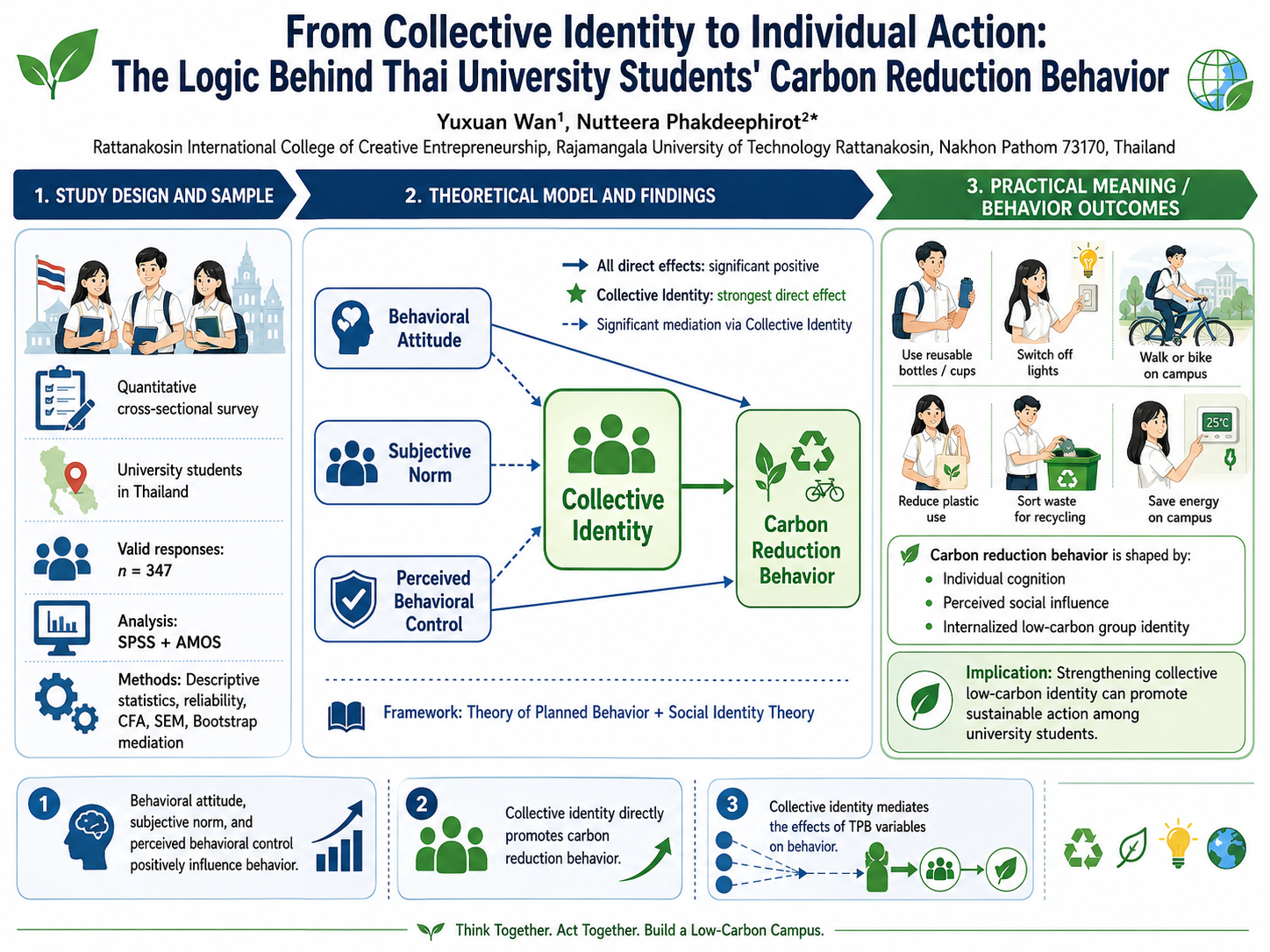
From Collective Identity to Individual Action: The Logic Behind Thai University Students' Carbon Reduction Behavior
Keywords:
Carbon Reduction Behavior; Collective Identity; Theory of Planned Behavior; Social Identity Theory; University Students; ThailaAbstract
This study aimed to examine the formation mechanism of carbon reduction behavior among university students in Thailand by integrating the Theory of Planned Behavior and Social Identity Theory. A quantitative cross-sectional survey was conducted using a structured questionnaire. Data were collected from university students studying in Thailand, and 347 valid responses were retained after data screening. SPSS and AMOS were used to conduct descriptive statistics, reliability analysis, confirmatory factor analysis, structural equation modeling, and Bootstrap mediation analysis. The results showed that behavioral attitude, subjective norm, perceived behavioral control, and collective identity all had significant positive effects on carbon reduction behavior. Collective identity had the strongest direct effect. The Bootstrap results further showed that collective identity significantly mediated the relationships between behavioral attitude and carbon reduction behavior, subjective norm and carbon reduction behavior, and perceived behavioral control and carbon reduction behavior. These findings indicate that carbon reduction behavior is shaped not only by individual cognitive factors and perceived social influence, but also by the internalization of low-carbon values as part of students’ shared group identity.
References
Ajzen, I. (1991). The theory of planned behavior. Organizational Behavior and Human Decision Processes, 50(2), 179–211. https://doi.org/10.1016/0749-5978(91)90020-T
Bamberg, S., & Möser, G. (2007). Twenty years after Hines, Hungerford, and Tomera: A new meta-analysis of psycho-social determinants of pro-environmental behaviour. Journal of Environmental Psychology, 27(1), 14–25. https://doi.org/10.1016/j.jenvp.2006.12.002
Cheung, G. W., Cooper-Thomas, H. D., Lau, R. S., & Wang, L. C. (2024). Reporting reliability, convergent and discriminant validity with structural equation modeling: A review and best-practice recommendations. Asia Pacific Journal of Management, 41, 745–783. https://doi.org/10.1007/s10490-023-09871-y
Cheung, M. W.-L. (2009). Comparison of methods for constructing confidence intervals of standardized indirect effects. Behavior Research Methods, 41(2), 425–438. https://doi.org/10.3758/BRM.41.2.425
Cialdini, R. B., Reno, R. R., & Kallgren, C. A. (1990). A focus theory of normative conduct: Recycling the concept of norms to reduce littering in public places. Journal of Personality and Social Psychology, 58(6), 1015–1026. https://doi.org/10.1037/0022-3514.58.6.1015
Etikan, I., Musa, S. A., & Alkassim, R. S. (2016). Comparison of convenience sampling and purposive sampling. American Journal of Theoretical and Applied Statistics, 5(1), 1–4. https://doi.org/10.11648/j.ajtas.20160501.11
Farrow, K., Grolleau, G., & Ibanez, L. (2017). Social norms and pro-environmental behavior: A review of the evidence. Ecological Economics, 140, 1–13. https://doi.org/10.1016/j.ecolecon.2017.04.017
Fielding, K. S., & Hornsey, M. J. (2016). A social identity analysis of climate change and environmental attitudes and behaviors: Insights and opportunities. Frontiers in Psychology, 7, Article 121. https://doi.org/10.3389/fpsyg.2016.00121
Fornell, C., & Larcker, D. F. (1981). Evaluating structural equation models with unobservable variables and measurement error. Journal of Marketing Research, 18(1), 39–50. https://doi.org/10.1177/002224378101800104
Fritsche, I., Barth, M., Jugert, P., Masson, T., & Reese, G. (2018). A social identity model of pro-environmental action (SIMPEA). Psychological Review, 125(2), 245–269. https://doi.org/10.1037/rev0000090
Hornsey, M. J. (2008). Social identity theory and self-categorization theory: A historical review. Social and Personality Psychology Compass, 2(1), 204–222. https://doi.org/10.1111/j.1751-9004.2007.00066.x
Iacobucci, D. (2010). Structural equations modeling: Fit indices, sample size, and advanced topics. Journal of Consumer Psychology, 20(1), 90–98. https://doi.org/10.1016/j.jcps.2009.09.003
Kollmuss, A., & Agyeman, J. (2002). Mind the gap: Why do people act environmentally and what are the barriers to pro-environmental behavior? Environmental Education Research, 8(3), 239–260. https://doi.org/10.1080/13504620220145401
Sedgwick, P. (2014). Statistical Question Cross sectional studies: advantages and disadvantages. BMJ-British Medical Journal, 348,g2276.
https://doi.org/10.1136/bmj.g2276
Steg, L., & Vlek, C. (2009). Encouraging pro-environmental behaviour: An integrative review and research agenda. Journal of Environmental Psychology, 29(3), 309–317. https://doi.org/10.1016/j.jenvp.2008.10.004
Stern, P. C. (2000). Toward a coherent theory of environmentally significant behavior. Journal of Social Issues, 56(3), 407–424. https://doi.org/10.1111/0022-4537.00175
Tavakol, M., & Dennick, R. (2011). Making sense of Cronbach’s alpha. International Journal of Medical Education, 2, 53–55. https://doi.org/10.5116/ijme.4dfb.8dfd
Wright, K. B. (2005). Researching Internet-based populations: Advantages and disadvantages of online survey research, online questionnaire authoring software packages, and web survey services. Journal of Computer-Mediated Communication, 10(3), Article JCMC1034. https://doi.org/10.1111/j.1083-6101.2005.tb00259.x