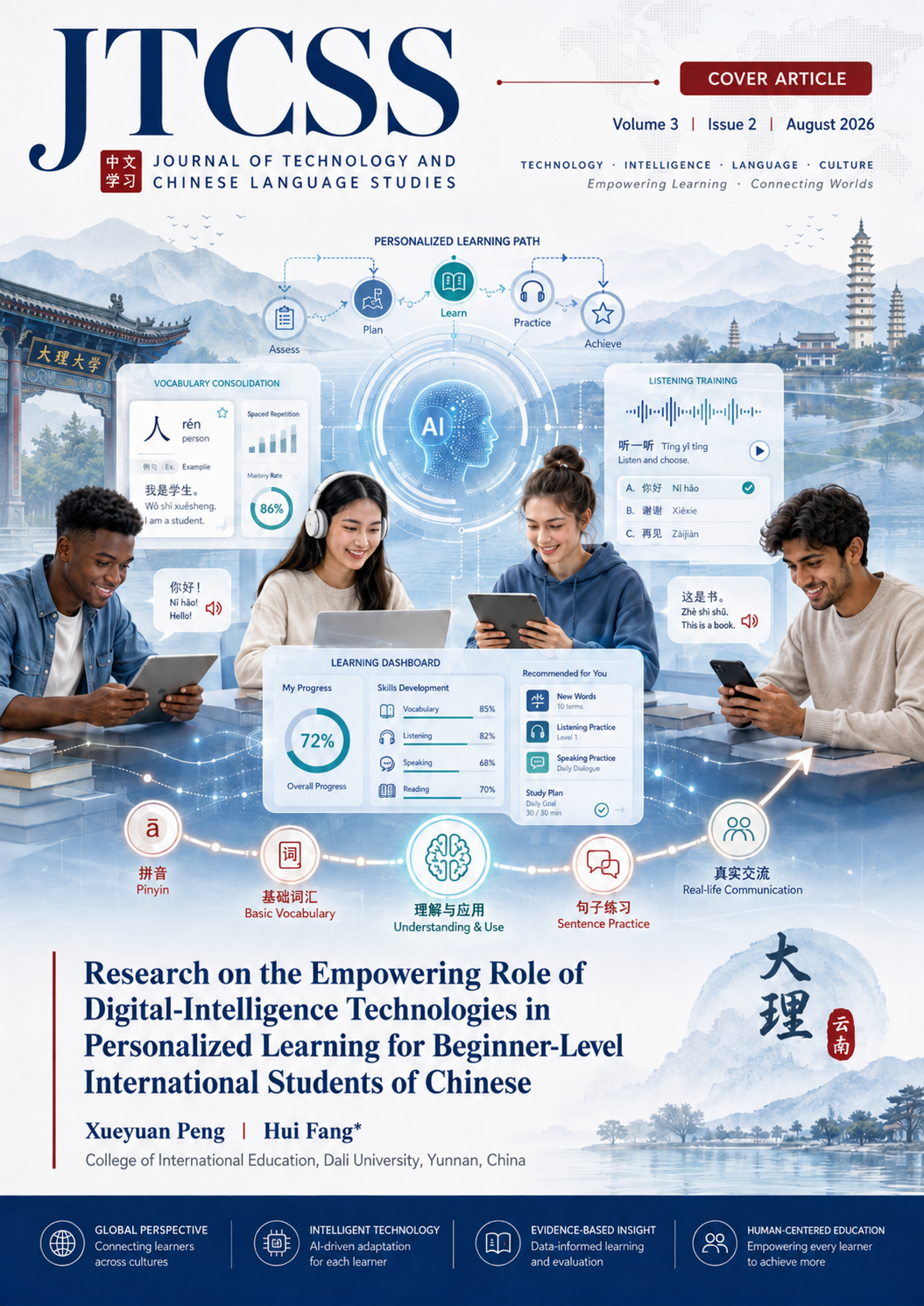
Research on the Empowering Role of Digital-Intelligence Technologies in Personalized Learning for Beginner-Level International Students of Chinese
Keywords:
Digital-Intelligence Technologies; Elementary Chinese Teaching; Personalized Learning; International Chinese EducationAbstract
Against the backdrop of the continuous integration of digital-intelligence technologies into educational practice, beginner-level Chinese language learning has exhibited a parallel trend toward platformization and personalization. Based on questionnaire data and statistical analysis of international students at local universities in Yunnan Province, this study systematically examines the current application status and structural characteristics of digital-intelligence technologies in personalized learning for elementary Chinese. The findings indicate that digital-intelligence tools demonstrate a relatively high level of adoption and are positively perceived by learners. They provide significant support particularly in vocabulary consolidation and listening training. However, several challenges remain, including an overemphasis on basic language skills, fragmented platform usage, and insufficient perceived personalization support. In response, this study proposes optimization strategies from three dimensions: the integration of comprehensive language competencies, the systematization of learning pathways, and the construction of data-driven regulation mechanisms, with the aim of promoting the structural development and sustained enhancement of language proficiency.
References
Arnseth, H. C. (2008). Activity theory and situated learning theory: contrasting views of educational practice. Pedagogy, Culture & Society, 16(3), 289-302. https://doi.org/10.1080/14681360802346663
Brownell, S. E., & Kloser, M. J. (2015). Toward a conceptual framework for measuring the effectiveness of course-based undergraduate research experiences in undergraduate biology. Studies in Higher Education, 40(3), 525-544.https://doi.org/10.1080/03075079.2015.1004234
Dimitrieska, V. (2024). Language teacher identity construction: Reflective conversation. Journal of Language, Identity & Education, 23(5), 771-786. https://doi.org/10.1080/15348458.2022.2054418
Duschl, R., Maeng, S., & Sezen, A. (2011). Learning progressions and teaching sequences: A review and analysis. Studies in Science Education, 47(2), 123-182.https://doi.org/10.1080/03057267.2011.604476
Fang, J., & Guo, J. (2025). Role of intercultural mediators: identity construction and negotiation in Lin Yutang’s trans-edited The Wisdom of Laotse. Cogent Arts & Humanities, 12(1), 2587103. https://doi.org/10.1080/23311983.2025.2587103
Lee, H. W., Lim, K. Y., & Grabowski, B. L. (2010). Improving self-regulation, learning strategy use, and achievement with metacognitive feedback. Educational Technology Research and Development, 58(6), 629-648. https://doi.org/10.1007/s11423-010-9153-6
Li, D., Song, Y., Hu, X., Qian, S., & Yu, X. (2026). Teachers’ digital intelligence learning competence (TDILC): a literature map from Chinese and global perspectives. Interactive Learning Environments, 1-35. https://doi.org/10.1080/10494820.2026.2614087
Pimmer, C. (2016). Mobile learning as boundary crossing: an alternative route to technology-enhanced learning? Interactive Learning Environments, 24(5), 979-990. https://doi.org/10.1080/10494820.2015.1128211
Sarason, Y., Dean, T., & Dillard, J. F. (2006). Entrepreneurship as the nexus of individual and opportunity: A structuration view. Journal of business venturing, 21(3), 286-305. https://doi.org/10.1016/j.jbusvent.2005.02.007
Shen, H. H. (2004). Level of cognitive processing: Effects on character learning among non-native learners of Chinese as a foreign language. Language and Education, 18(2), 167-182. https://doi.org/10.1080/09500780408666873
Sommerville, J. A., Upshaw, M. B., & Loucks, J. (2012). The nature of goal-directed action representations in infancy. In Advances in Child Development and Behavior, 3, 351-387. https://doi.org/10.1016/B978-0-12-397919-3.00013-7
Stiakakis, E., & Barboutidis, G. (2022). Exploring the construct of the new way of thinking in the digital environment. Behaviour & Information Technology, 41(13), 2779-2795. https://doi.org/10.1080/0144929X.2021.1949042
Thompson, M. (2012). People, practice, and technology: Restoring Giddens' broader philosophy to the study of information systems. Information and Organization, 22(3), 188-207. https://doi.org/10.1016/j.infoandorg.2012.04.001
Toom, A., Pyhältö, K., & Rust, F. O. C. (2015). Teachers’ professional agency in contradictory times. Teachers and Teaching, 21(6), 615-623. https://doi.org/10.1080/13540602.2015.1044334
Van Rooyen, M. (2013). Structure and agency in news translation: An application of Anthony Giddens’ structuration theory. Southern African linguistics and applied language studies, 31(4), 495-506. https://doi.org/10.2989/16073614.2013.864445