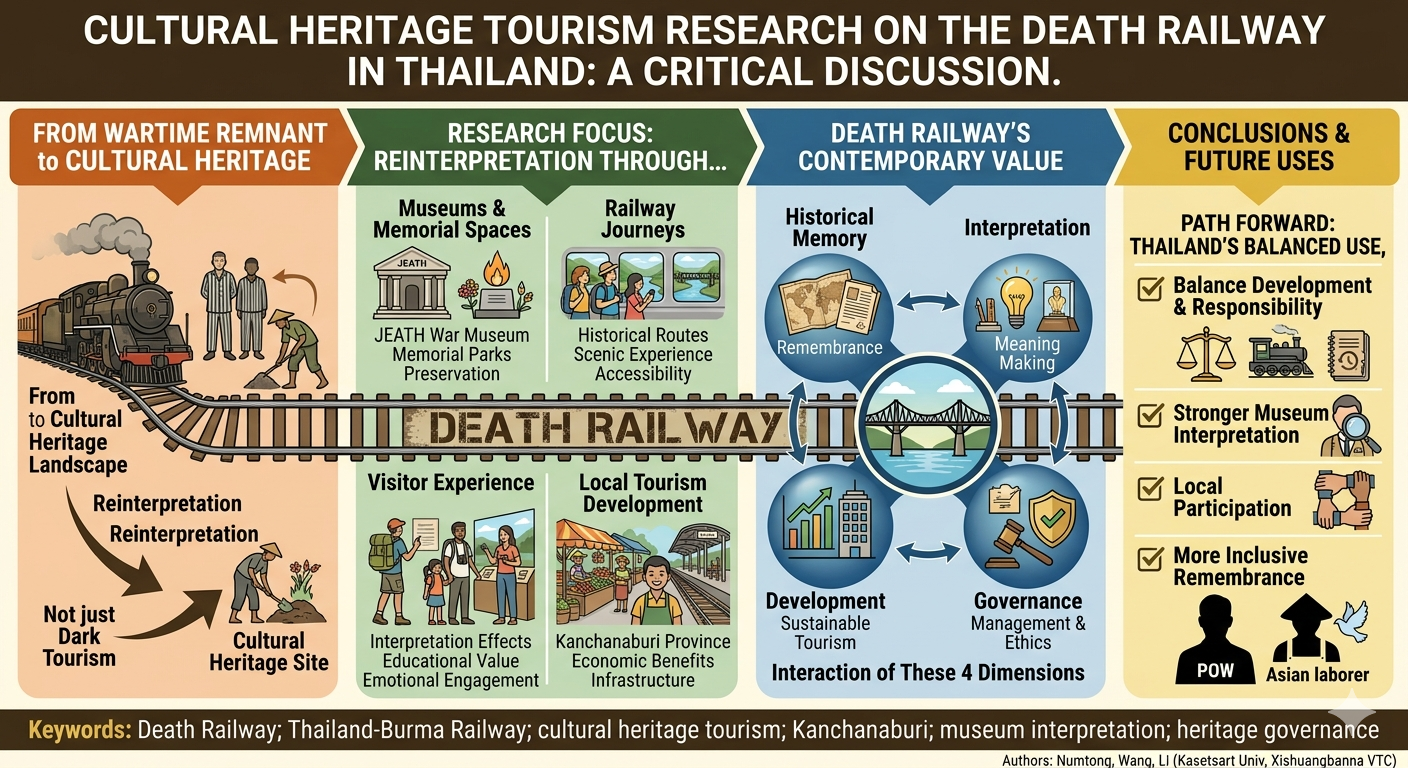
A Review of Cultural Heritage Tourism Research on the Death Railway in Thailand
Keywords:
Death Railway, Thailand-Burma Railway, cultural heritage tourism, Kanchanaburi, museum interpretation, heritage governanceAbstract
This article critically discusses the Death Railway in Thailand as a cultural heritage tourism landscape rather than merely as a wartime remnant or dark tourism attraction. Focusing on Kanchanaburi, it examines how the railway has been reinterpreted through museums, memorial spaces, railway journeys, visitor experience, local tourism development, and heritage governance. The discussion argues that the Death Railway’s contemporary value lies in the interaction between historical memory, interpretation, development, and governance. It concludes that Thailand’s future use of the Death Railway should balance tourism development with historical responsibility, stronger museum interpretation, local participation, and more inclusive remembrance of both prisoners of war and Asian labourers.
References
Aas, C., Ladkin, A., & Fletcher, J. (2005). Stakeholder collaboration and heritage management. Annals of Tourism Research, 32(1), 28–48. https://doi.org/10.1016/j.annals.2004.04.005
Arrunnapaporn, A. B. (2011). Guidelines for interpretation and development of new tourism destinations along the ‘Death Railway’, Kanchanaburi, Thailand. Silpakorn University Journal, 31(2), 6–20.
Arrunnapaporn, A. B. (2012). Atrocity heritage tourism at the “Death Railway”. The Journal of the Siam Society, 100, 256–268.
Biran, A., Poria, Y., & Oren, G. (2011). Sought experiences at (dark) heritage sites. Annals of Tourism Research, 38(3), 820–841. https://doi.org/10.1016/j.annals.2010.12.001
Chhabra, D., Healy, R., & Sills, E. (2003). Staged authenticity and heritage tourism. Annals of Tourism Research, 30(3), 702–719. https://doi.org/10.1016/S0160-7383(03)00044-6
Dharawanij, N. (2020). The development of cultural heritage tourism at Sangkhlaburi District, Kanchanaburi Province, Thailand. Social Sciences, 9(3), 77–81. https://doi.org/10.11648/j.ss.20200903.13
Garrod, B., & Fyall, A. (2000). Managing heritage tourism. Annals of Tourism Research, 27(3), 682–708. https://doi.org/10.1016/S0160-7383(99)00094-8
Husa, L. C. (2023). Disneyfying atrocities: Cultures and politics of remembering the Thai-Burma Death Railway: An analysis of Thai dark tourism. Journal of Language and Culture, 42(1), 63–90.
Lennon, J. (2018). Kanchanaburi and the Thai-Burma Railway: Disputed narratives in the interpretation of war. International Journal of Tourism Cities, 4(1), 140–155. https://doi.org/10.1108/IJTC-06-2017-0033
Light, D. (2017). Progress in dark tourism and thanatourism research: An uneasy relationship with heritage tourism. Tourism Management, 61, 275–301. https://doi.org/10.1016/j.tourman.2017.01.011
McKercher, B., & du Cros, H. (2002). Cultural tourism: The partnership between tourism and cultural heritage management. Haworth Hospitality Press.
Poria, Y., Butler, R., & Airey, D. (2003). The core of heritage tourism. Annals of Tourism Research, 30(1), 238–254. https://doi.org/10.1016/S0160-7383(02)00064-6
Riddhagni, N. (2018). Cultural tourism and architecture heritage: Question of authenticity. Journal of Community Development Research (Humanities and Social Sciences), 11(3), 1–12. https://doi.org/10.14456/jcdr-hs.2018.9
Stone, P. R. (2006). A dark tourism spectrum: Towards a typology of death and macabre related tourist sites, attractions and exhibitions. Tourism, 54(2), 145–160.