Theoretical Adaptability and Mechanism of the "Jinjiang Experience" in Leading the Innovative Development of Digital Cultural Tourism
Keywords:
Jinjiang Experience; Digital Cultural Tourism; Theoretical Adaptability; Functioning Mechanism; Innovative DevelopmentAbstract
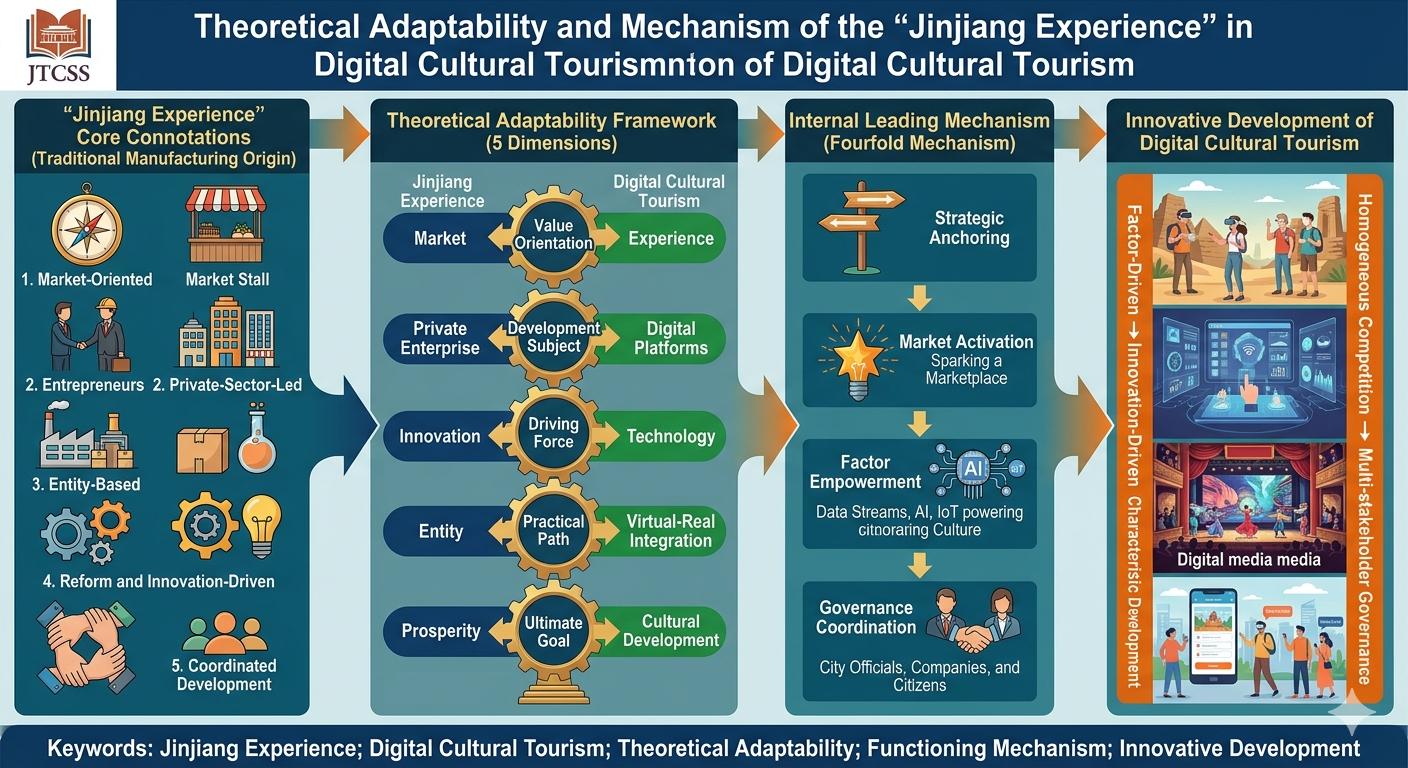
Against the backdrop of the 15th Five-Year Plan explicitly proposing the innovative development of the "Jinjiang Experience", digital cultural tourism, as a new form of integrated modern service industry and digital economy, urgently requires adaptable localized theoretical guidance for its high-quality development. This study extends the application scenario of China's "Jinjiang Experience" from traditional manufacturing to the field of digital cultural tourism, aiming to systematically deconstruct the theoretical adaptability between the two and reveal the internal mechanism of its leading role. Through literature review and theoretical deduction, this paper first clarifies the core connotation and contemporary significance of the "Jinjiang Experience": market-oriented, private-sector-led, entity-based, reform and innovation-driven, and coordinated development. Furthermore, it constructs an analytical framework for the theoretical adaptability between the "Jinjiang Experience" and the innovative development of digital cultural tourism from five dimensions: value orientation, development subject, driving force, practical path, and ultimate goal. The study argues that the "Jinjiang Experience" leads digital cultural tourism to achieve profound transformations from factor-driven to innovation-driven, from homogeneous competition to characteristic development, and from government-led to multi-stakeholder governance through the fourfold mechanism of "strategic anchoring – market activation – factor empowerment – governance coordination".
References
Ammirato, S., Felicetti, A. M., Linzalone, R., & Carlucci, D. (2022). Digital business models in cultural tourism. International Journal of Entrepreneurial Behavior & Research, 28(8), 1940-1961. https://doi.org/10.1108/IJEBR-01-2021-0070
Bekele, H., & Raj, S. (2024). Digitalization and Digital Transformation in the Tourism Industry: A Bibliometric Review and Research Agenda. Tourism Review, 80(4),894-913. https://doi.org/10.1108/TR-07-2023-0509
Chen, S., & Zhao, C. (2025). "Jinjiang Experience": County-level Practice on the Road to Common Prosperity. Journal of Liming Vocational University, (4), 37–42. https://doi.org/10.13446/j.cnki.jlvu.202502001
Dayoub, B., Yang, P., Omran, S., Zhang, Q., & Dayoub, A. (2024). Digital Silk Roads: Leveraging the Metaverse for Cultural Tourism within the Belt and Road Initiative Framework. Electronics, 13, 29. https://doi.org/10.3390/electronics13122306
Gutierriz, I., Ferreira, J. J., & Fernandes, P. (2023). Digital transformation and the new combinations in tourism: A systematic literature review. Tourism and Hospitality Research, 25(2),194-213. https://doi.org/10.1177/14673584231198414
Guo, J. (2023). Analysis of the Connotation Characteristics and Innovative Development of the "Jinjiang Experience". Forum on Leadership Science, (6), 35–37. https://doi.org/10.19299/j.cnki.42-1837/C.2023.06.007
Jiang, C., & Phoong, S. W. (2023). A ten-year review analysis of the impact of digitization on tourism development (2012–2022). Humanities and Social Sciences Communications, 10(1),1-16.https://doi.org/10.1057/s41599-023-02150-7
Kasemsarn, K., Harrison, D., & Nickpour, F. (2023). Applying Inclusive Design and Digital Storytelling to Facilitate Cultural Tourism: A Review and Initial Framework. Heritage, 6, 1411-1428. https://doi.org/10.3390/heritage6020077
Kumar, S., Kumar, V., Bhatt, I., Kumar, S., & Attri, K. (2023). Digital transformation in tourism sector: trends and future perspectives from a bibliometric-content analysis. Journal of Hospitality and Tourism Insights, 7(3),1553-1576. https://doi.org/10.1108/JHTI-10-2022-0472
Li, B., & Chen, F. (2024). The Generation Logic, Ideological Connotation and Contemporary Value of the "Jinjiang Experience". Journal of Xiamen University of Technology, 32(6), 1–8. https://doi.org/10.19697/j.cnki.1673-4432.202406001
Lin, H., & Zhai, X. (2024). Promoting High-quality Development of County Economy with a Systemic Perspective: Reconsideration of the "Jinjiang Experience". Southeast Academic Journal, (3), 31–40. https://doi.org/10.13658/j.cnki.sar.2024.03.003
Liu, H. (2025). The Generation Logic, Theoretical Construction and Policy Implications of the "Jinjiang Experience": An Explanation Framework Based on Complex Economic Systems. Journal of Finance and Economics, 10(3), 5–22+145–146. https://doi.org/10.20032/j.cnki.cn10-1359/f.2025.03.002
Liu, H., & Xu, P. (2023). Exploration of High-quality Development of Private Economy in the New Development Stage Based on the "Jinjiang Experience". Journal of Qiqihar University (Philosophy and Social Sciences Edition), 11, 96–101. https://doi.org/10.13971/j.cnki.cn23-1435/c.2023.11.021
Ratna, S., Saide, S., Putri, A., Indrajit, R., & Muwardi, D. (2023). Digital transformation in tourism and hospitality industry: a literature review of blockchain, financial technology, and knowledge management. EuroMed Journal of Business, 19(1),84-112. https://doi.org/10.1108/EMJB-04-2023-0118
Roziqin, A., Kurniawan, A., Hijri, Y., & Kismartini, K. (2023). Research trends of digital tourism: a bibliometric analysis. Tourism Critiques: Practice and Theory, 4(1),28-47. https://doi.org/10.1108/TRC-11-2022-0028
Tang, C., Lingyi, S., Limei, L., & Jianghai, M. (2024). The Model and Path for Digital Cultural Tourism to Promote Rural Revitalization. Journal of Resources and Ecology, 15(3),528-540. https://doi.org/10.5814/j.issn.1674-764x.2024.03.002
Wang, L., & Wang, F. (2025). The Exploration, Proposal and Innovative Development of the "Jinjiang Experience". Journal of Pingxiang University, 42(2), 27–31. https://doi.org/10.20229/j.cnki.2095-9249.000069
Wang, M. (2025). Circular Transformation of Industrial Parks and Green Development of County Economy: Interpretation and Implications of the "Jinjiang Experience". Chemical Engineering and Equipment, (8), 166–167. https://doi.org/10.19566/j.cnki.cn35-1285/tq.2025.08.037
Wider, W., Gao, Y., Chan, C. K., Lin, J., Li, J., Tanucan, J. C. M., & Fauzi, M. A. (2023). Unveiling trends in digital tourism research: A bibliometric analysis of co-citation and co-word analysis. Environmental and Sustainability Indicators, 20, 100308. https://doi.org/10.1016/j.indic.2023.100308
Wu, W., Xu, C., Zhao, M., Li, X., & Law, R. (2024). Digital Tourism and Smart Development: State-of-the-Art Review. Sustainability, 16, 10382. https://doi.org/10.3390/su162310382
Yanti, D., Heryadi, D., Juliana, J., Cakranegara, P. A., & Kadyrov, M. (2023). Developing rural communication through digital innovation for village tourism. Jurnal Studi Komunikasi (Indonesian Journal of Communications Studies), 7, 696-712. https://doi.org/10.25139/jsk.v7i3.7384
Zeqiri, A., Youssef, A., & Maherzi, T. (2025). The Role of Digital Tourism Platforms in Advancing Sustainable Development Goals in the Industry 4.0 Era. Sustainability, 17(8),3842. https://doi.org/10.3390/su17083482
Zhao, X., Xie, C., Huang, L., Wang, Y., & Han, T. (2023). How digitalization promotes the sustainable integration of culture and tourism for economic recovery. Economic Analysis and Policy, 77, 988-1000. https://doi.org/10.1016/j.eap.2023.01.005
Zhang, X., Shi, J., & Hong, Y. (2023). "Jinjiang Experience" of Chinese County-level Modernization. China Economic Issues, (2), 6–22. https://doi.org/10.19365/j.issn1000-4181.2023.02.02
Zheng, D., Huang, C., & Oraltay, B. (2023). Digital cultural tourism: progress and a proposed framework for future research. Asia Pacific Journal of Tourism Research, 28, 234-253. https://doi.org/10.1080/10941665.2023.2217958