The Mechanism of Social Security on Household Saving Behavior from the Perspective of Multidimensional Preferences
Keywords:
Multidimensional Preferences; Social Security Level; Household Saving Behavior; Precautionary Saving Motivation; Mediating EffectAbstract
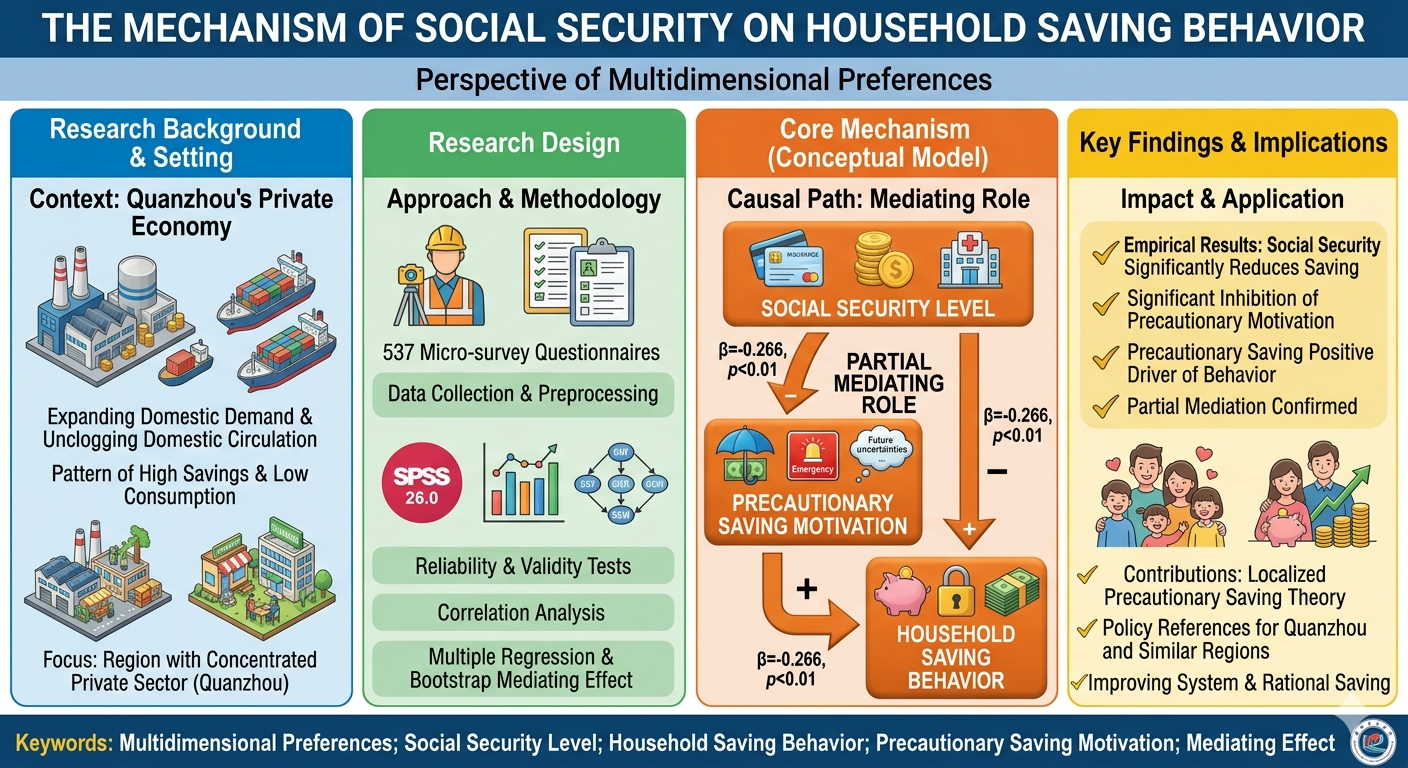
Against the macro background of expanding domestic demand and unclogging the domestic circulation in China, the pattern of high savings and low consumption among urban and rural residents has not been fundamentally changed. Relevant academic discussions still lack sufficient micro-level paths and quantitative evidence on how social security affects household saving behavior in regions with concentrated private sectors. This paper takes Quanzhou, a city with a highly developed private economy, as the research setting to systematically examine the effect of social security on local residents’ household saving behavior and test the mediating role of precautionary saving motivation therein. Based on 537 micro-survey questionnaire data, this study employs SPSS 26.0 to conduct reliability and validity tests, descriptive statistics, correlation analysis, multiple regression, and the Bootstrap mediating effect test. The empirical results show that social security has a significant negative effect on residents’ saving behavior in Quanzhou (β=-0.266, p<0.01) and significantly inhibits precautionary saving motivation; precautionary saving motivation has a significant positive driving effect on saving behavior and plays a partial mediating role between social security and saving behavior. This paper enriches the micro-empirical findings on household saving behavior in regions with a vibrant private economy, advances the localized application of precautionary saving theory, and can provide decision-making references for Quanzhou and similar regions to improve the social security system and guide residents to save and consume rationally.
References
Anquan, Z., Wanying, Z., Ruoxuan, H., & Lailiang, Z. (2024). Importance of precautionary savings for urban Chinese households. Review of Economics of the Household,1-25. https://doi.org/10.1007/s11150-024-09754-1
Bhat, M., Gomero, G., & Tariq Khan, S. (2022). Antecedents of Savings Behaviour Among Rural Households: A Holistic Approach. FIIB Business Review, 13, 231971452211102. https://doi.org/10.1177/23197145221110281
Błoch, W. (2023). What drives the savings rate in middle-income countries? Economics and Business Review, 9(4),56-73. https://doi.org/10.18559/ebr.2023.4.1072
Castaldo, S., & Tirelli, M. (2025). Subjective income risk and precautionary saving. Economic Modelling, 143, 106965. https://doi.org/10.1016/j.econmod.2024.106965
Elias, H., Beshir, M., & Mehare, A. (2022). Household Saving Behavior in Rural Ethiopia: Challenges and Policy Options. Ethiopian Journal of Economics, 31(2), 33-72. https://ethiopianjournalofeconomics.org/index.php/EJE/article/view/245
Fialová, K. (2026). Understanding precautionary savings behaviour: Insights from Czechia. The Social Science Journal, 63(1), 136-158. https://doi.org/10.1080/03623319.2024.2424639
García-Miralles, E., & Leganza, J. (2024). Public Pensions and Private Savings. American Economic Journal: Economic Policy, 16, 366-405. https://doi.org/10.1257/pol.20220019
Ghosh, S., & Nath, H. (2023). What determines private and household savings in India? International Review of Economics & Finance, 86,639-651. https://doi.org/10.1016/j.iref.2023.03.032
Guo, K., & Tian, X. (2022). Accelerating the Construction of New Development Pattern and the Paths of Manufacturing Transformation and Upgrading. China Finance and Economic Review, 11, 3-23. https://doi.org/10.1515/cfer-2022-0001
Hasan, A., & Rahman, M. T. (2023). Family takāful purchase intentions in Bangladesh: the mediating role of attitude and saving motives and the moderating role of religiosity. Islamic Economic Studies, 31(1),2-21. https://doi.org/10.1108/IES-03-2023-0012
He, J., & Liu, Y. (2024). Digital inclusion finance, social governance and household investment decisions. Finance Research Letters, 62, 105250. https://doi.org/10.1016/j.frl.2024.105250
Hong, M., Wang, J., & Tian, M. (2022). Rural Social Security, Precautionary Savings, and the Upgrading of Rural Residents’ Consumption Structure in China. Sustainability, 14, 12455. https://doi.org/10.3390/su141912455
Horioka, C., & Ventura, L. (2022). Do the Retired Elderly in Europe Decumulate Their Wealth? The Importance of Bequest Motives, Precautionary Saving, Public Pensions, and Homeownership. Review of Income and Wealth,70(1),187-212. https://doi.org/10.1111/roiw.12632
Jing, P., Zhao, S., & Wang, M. (2025). From savings to investments: How retirement consumption expectations shape household risky financial asset allocation. Pacific-Basin Finance Journal, 93, 102828. https://doi.org/10.1016/j.pacfin.2025.102828
Kalinowski, S., Łuczak, A., & Koziolek, A. (2022). The Social Dimension of Security: The Dichotomy of Respondents’ Perceptions during the COVID-19 Pandemic. Sustainability, 14, 1363. https://doi.org/10.3390/su14031363
Korzeniowska, A., & Ulman, P. (2023). Household saving motives and socio-demographic factors. Ruch Prawniczy, Ekonomiczny i Socjologiczny, 85, 177-197. https://doi.org/10.14746/rpeis.2023.85.4.09
Li, Y., Wen, L., Qiu, R. T. R., & Liu, C. (2026). Housing wealth, mortgage debt, and tourism demand: Navigating urban-rural institutional divides and financial constraints in the context of China. Tourism Management, 114, 105381. https://doi.org/10.1016/j.tourman.2025.105381
Mazengiya, M. N., Seraw, G., Melesse, B., & Belete, T. (2022). “Determinants of rural household saving participation: A case study of Libokemkem District, North-west Ethiopia”. Cogent Economics & Finance, 10(1), 2127219. https://doi.org/10.1080/23322039.2022.2127219
Painter, G., Yang, X., & Zhong, N. (2022). Housing Wealth as Precautionary Saving: Evidence from Urban China. Journal of Financial and Quantitative Analysis, 57(2), 761-789. https://doi.org/10.1017/S0022109021000065
Parker, J., Schoar, A., Cole, A., & Simester, D. (2025). Household Portfolios and Retirement Saving over the Life Cycle. The Journal of Finance, 80, 2739-2787. https://doi.org/10.1111/jofi.13473
Sun, R., & Xiong, X. (2023). The Impact of Income on Rural Residents’ Retirement Saving: Evidence from China. Agriculture, 13, 1756. https://doi.org/10.3390/agriculture13091756
Wang, Y., & Tian, R. (2023). Development of Rural Regions in China: Evidence of Industry Integration by the Residents of Yongan Village (Quanzhou City, China). Sustainability, 15, 2928. https://doi.org/10.3390/su15042928
Xin, X., Zhang, A., & Liu, L. (2024). Study on the influence of Internet finance on urban household savings rate: Evidence from China. International Review of Economics & Finance, 90, 45-61. https://doi.org/10.1016/j.iref.2023.11.003
Zafar, M. B. (2026). Happiness, Economic Shocks, and Household Savings: A Multi-country Mixed-effects Analysis. Journal of Family and Economic Issues, 47(1), 207-227. https://doi.org/10.1007/s10834-026-10076-w
Zeng, M., Du, J., Zhu, X., & Deng, X. (2023). Does internet use drive rural household savings? Evidence from 7825 farmer households in rural China. Finance Research Letters, 57, 104275. https://doi.org/10.1016/j.frl.2023.104275
Zhang, L., Brooks, R., Ding, D., Ding, H., He, H., Lu, J., & Mano, R. C. (2025). China's high savings: Drivers, prospects, and policy implications. Emerging Markets Review, 69, 101355. https://doi.org/10.1016/j.ememar.2025.101355
Zhang, Y., Zhang, X., & Liu, M. (2024). A Study on the Factors Influencing Household Consumption from a Money Demand Perspective: Evidence from Chinese Urban Residents. Sustainability, 16(1), 322. https://doi.org/10.3390/su16010322