Understanding Virtual Agglomeration Dynamics in the Digital Age: Empirical Evidence from China’s Provinces
Keywords:
virtual agglomeration, human capital, new quality productivity, high-quality development of China's economy, innovationAbstract
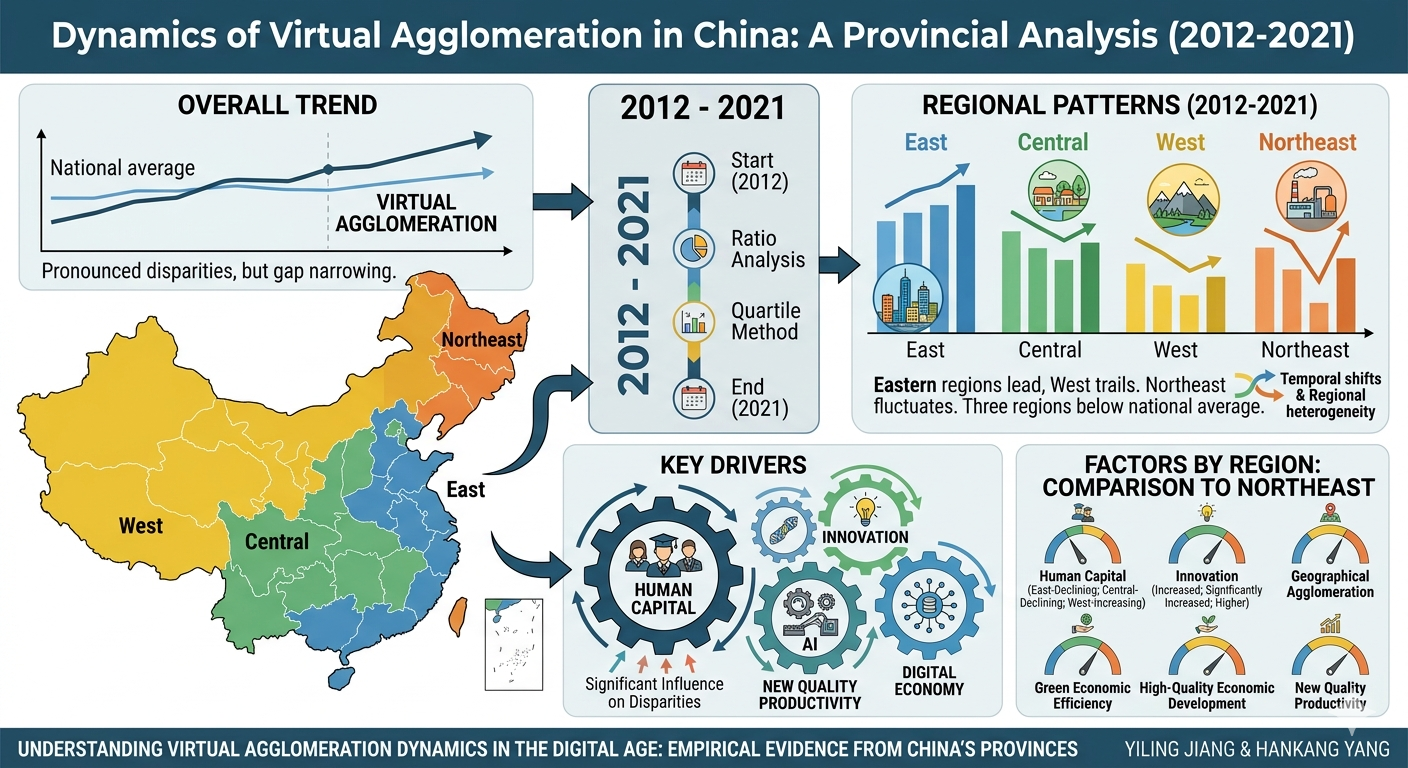
This study examines the spatial distribution of virtual agglomeration across Chinese provinces from 2012 to 2021, using regional grouping, the ratio to the national average, and the quartile method to analyze the overall trend of virtual agglomeration in China and the changes across 31 provinces (including municipalities). The study explores the persistence and volatility of virtual agglomeration, as well as the temporal trajectories of nine closely related factors. Our findings reveal a pronounced disparity in virtual agglomeration across provinces, although this gap appears to be narrowing. Human capital emerges as a significant factor influencing variations in virtual agglomeration. Furthermore, virtual agglomeration exhibits substantial temporal shifts and regional heterogeneity, with the eastern regions leading and the western regions trailing, reflecting an imbalanced development trajectory. Compared to the Northeast, the East shows declining human capital, increased innovation, stronger geographical agglomeration, weaker digital economy, higher green economic efficiency, higher domestic value-added in exports, lower high-quality economic development, and stronger new quality productivity. The Central region shows declining human capital, significantly increased innovation, very strong geographical agglomeration, a stronger digital economy, higher green economic efficiency, higher domestic value-added in exports, lower high-quality economic development, and weaker new quality productivity. The West shows increasing human capital, higher innovation, weaker geographical agglomeration, a weaker digital economy, higher green economic efficiency, higher domestic value-added in exports, lower high-quality economic development, and stronger new quality productivity. These factors influence virtual agglomeration, ultimately leading to the highest levels in the East, followed by the Central and Western regions, while the Northeast exhibits fluctuations. The latter three regions have consistently been below the national average. Therefore, the virtual agglomeration levels in areas outside the East, particularly in the Western and Northeastern regions, should be further enhanced.
References
An, C., Wang, J., & Zhou, C. (2026). The evolution and current landscape of AI in geographical research: A large-scale systematic review. Geography and Sustainability, 7(1), 100392. https://doi.org/10.1016/j.geosus.2025.100392
Chen, X., Liu, C., Jiang, Y., & Gao, C. (2021). What Causes the Virtual Agglomeration of Creative Industries? Sustainability, 13, 9232.https://doi.org/10.3390/su13169232
Duan, X., & Zhang, Q. (2023). Industrial digitization, virtual agglomeration and total factor productivity. Journal of Northwest Normal University (Social Sciences), 60(1), 135-144. https://doi.org/10.16783/J.cnki.nwnus.2023.01.016
Gu, R., Li, C., Yang, Y., & Zhang, J. (2023). The impact of industrial digital transformation on green development efficiency considering the threshold effect of regional collaborative innovation: Evidence from the Beijing-Tianjin-Hebei urban agglomeration in China. Journal of Cleaner Production, 420, 138345.https://doi.org/10.1016/j.jclepro.2023.138345
Guo, D., Li, L., & Pang, G. (2024). Does the integration of digital and real economies promote urban green total factor productivity? Evidence from China. Journal of Environmental Management, 370, 122934.https://doi.org/10.1016/j.jenvman.2024.122934
Heping, G., & Fuxiang, W. (2022). Digital Economy Enables High-Quality Economic Development: Theoretical Mechanisms and Empirical Evidence. Frontiers of Economics in China, 17(4), 643-668.https://doi.org/10.3868/s060-015-022-0027-7
Ikhlash, M., & Sembiring, T. (2026). Peer-to-Peer Lending: Growth, Trends, and Economic Impact Analysis. Jurnal Siasat Bisnis, 30, 66-87. https://doi.org/10.20885/jsb.vol30.iss1.art5
Jankowska, B., Maria, E. D., & Cygler, J. (2021). Do clusters matter for foreign subsidiaries in the Era of industry 4.0? The case of the aviation valley in Poland. European Research on Management and Business Economics, 27(2), 100150. https://doi.org/10.1016/j.iedeen.2021.100150
Kang, N., Xu, G., Mu, X., Yang, H., & Qiao, Y. (2022). How virtual clusters affect innovation performance: Evidence from global hydropower industry. Journal of Cleaner Production, 352, 131554. https://doi.org/10.1016/j.jclepro.2022.131554
Liu, H., Chen, W., Sun, S., Yu, J., Zhang, Y., & Ye, C. (2024). Revisiting China’s urban transition from the perspective of urbanisation: A critical review and analysis. Sustainability, 16(10), 4122. https://doi.org/10.3390/su16104122
Liu, H., Shi, Y., Sun, B., & Yang, X. (2023). Agglomeration of the Digital Services Industry and Digital Transformation: Evidence from China. Emerging Markets Finance and Trade, 60, 1-15.
https://doi.org/10.1080/1540496X.2023.2260545
Liu, Z., & Hou, K. (2025). Financial Agglomeration: Catalyst or Bottleneck for Industrial Chain Resilience?—Evidence from China. Networks and Spatial Economics,1-28.
https://doi.org/10.1007/s11067-025-09710-1
Liu, Z., Ling, Y., & Sun, R. (2023). The direction and strategy of industrial development under the new productivity: Taking Jiangsu Province as an example. Nanjing Journal of Social Sciences, 11, 59-66.
https://doi.org/10.16783/J.cnki.issn1001-8263.2023.11.007
Lu, J., Guo, Z. A., & Wang, Y. P. (2024). Levels of development of new quality productivity, regional differences and paths to enhancement. Journal of Chongqing University, Social Sciences Edition, 30(3), 1-17. https://doi.org/10.11835/j.issn.1008-5831.jg.2024.03.002
Lu, Y., & Zhu, S. (2022). Digital economy, scientific and technological innovation, and high-quality economic development: A mediating effect model based on the spatial perspective. Plos One, 17(11), e0277245. https://doi.org/10.1371/journal.pone.0277245
Mohammadi, N., Maghsoudi, M., & Abarghouezade, Z. (2026). Mapping entrepreneurial ecosystems through social media networks: A digital ecosystem approach. International Journal of Innovation Studies, 100197. https://doi.org/10.1016/j.ijis.2026.100197
Qiong, W., & Wei, Y. (2023). Research on the Influence of Digital Economy on Technological Innovation: Evidence from Manufacturing Enterprises in China. Sustainability, 15, 4995. https://doi.org/10.3390/su15064995
Ren, Y., Cheng, X., Niu, C., Yang, F., & Zheng, Y. (2024). Fertility intention of young people of childbearing age in China after the implementation of the two-child policy—A systematic review and meta-analysis. BMC Public Health, 24(1),3518. https://doi.org/10.1186/s12889-024-20956-1
Rui, J., & Xu, Z. (2026). From agglomeration to downgrading: Spatial differentiation and drivers of online and offline consumption downgrading in Chinese cities. Land Use Policy, 167, 108034. https://doi.org/10.1016/j.landusepol.2026.108034
Shen, Z., Liu, N., Li, X., & Kang, Z. (2022). A Method for Evaluating the Green Economic Efficiency of Resource-Based Cities Based on Neural Network Improved DEA Model. Computation Intelligences Neuroscience, 2022(1), 9521107. https://doi.org/10.1155/2022/9521107
Sun, H., Gui, H., & Yang, D. (2020). Measurement and evaluation of the high-quality of China’s provincial economic development. Zhejiang Social Sciences, 8, 4-14. https://doi.org/10.14167/j.zjss.2020.08.001
Sun, W.-z., Mao, N., Lan, F., & Wang, L. (2023). Policy empowerment, digital ecosystem and enterprise digital transformation: a quasi natural experiment based on the national big data comprehensive experimental zone. China Industrial Economics, 9, 117-135. https://doi.org/10.19581/j.cnki.ciejournal.2023.09.007
Vandyck, G. K., Aryee, J., Acheampong, G., & Hansen, A. S. (2026). Agglomeration dynamics and firm typologies in African port-industrial clusters: Evidence from the port of Tema, Ghana. Journal of Transport Geography, 131, 104548. https://doi.org/10.1016/j.jtrangeo.2026.104548
Wu, S., Li, B., & Xu, D. (2024). Agglomeration Characteristics and Influencing Factors of Urban Innovation Spaces Based on the Distribution Data of High-Tech Enterprises in Harbin. Buildings, 14(6), 1615. https://doi.org/10.3390/buildings14061615
Wu, Y., Liu, Y., Dai, Z., & Da, F. (2024). County-Level Economic Development Mode in the Context of China’s Rural Revitalization: A Fuzzy-Set Qualitative Comparative Analysis. Sage Open, 14(4), 21582440241299899. https://doi.org/10.1177/21582440241299899
Xia, L., Baghaie, S., & Mohammad Sajadi, S. (2024). The digital economy: Challenges and opportunities in the new era of technology and electronic communications. Ain Shams Engineering Journal, 15(2), 102411. https://doi.org/10.1016/j.asej.2023.102411
Yan, C., Liyezi, Z., & Wenbin, S. (2022). The Construction Path of Smart Services Enabling Innovative Urban Agglomeration: from the Perspective of Physical and Virtual Industrial Agglomeration. Science & Technology Progress and Policy, 39(9), 33-41. https://doi.org/10.6049/kjjbydc.2021110420
Yang, J., Wu, R., & Yang, H. (2023). Digital Transformation and Enterprise Sustainability: The Moderating Role of Regional Virtual Agglomeration. Sustainability, 15, 7597. https://doi.org/10.3390/su15097597
Yang, R. (2022). Space reconstruction process and internal driving mechanisms of Taobao villages in metropolitan fringe areas: A case study of Lirendong village in Guangzhou, China. Journal of Geographical Sciences, 32(12), 2599-2623. https://doi.org/10.1007/s11442-022-2063-9
Yang, S., Mengyu, H., & Xiuwu, Z. (2024). Assessing the impact of digital technologies on energy efficiency: the role of OFDI and virtual agglomeration. Journal of Resources and Ecology, 15(1), 117-129. https://doi.org/10.5814/j.issn.1674-764x.2024.01.010
Yuan, Y., Zhu, Y., Zhang, J., & Kang, M. (2026). Data Element Agglomeration, Regional Innovation Ecosystem and Innovation Quality. Sage Open, 16(1), 21582440251397451. https://doi.org/10.1177/21582440251397451
Yue, W., Nan, M., & Zhao, J. (2026). Market-Oriented Reform and Export Domestic Value-Added Rate of Firms: Evidence from China. The Singapore Economic Review,1-22. https://doi.org/10.1142/S0217590826500086
Zhang, Q., Ru, S., & Cheng, Y. (2023). Research on the measurement and characteristics of virtual agglomeration based on social network analysis: Evidence from 29 manufacturing industries in China. Systems, 11(12), 571. https://doi.org/10.3390/systems11120571