Practical Reflections on AI-Powered KPI Performance Improvement from the Perspective of Hospital Managers
Keywords:
Artificial Intelligence, Hospital Management, KPI Performance, Refined Management, High-Quality DevelopmentAbstract
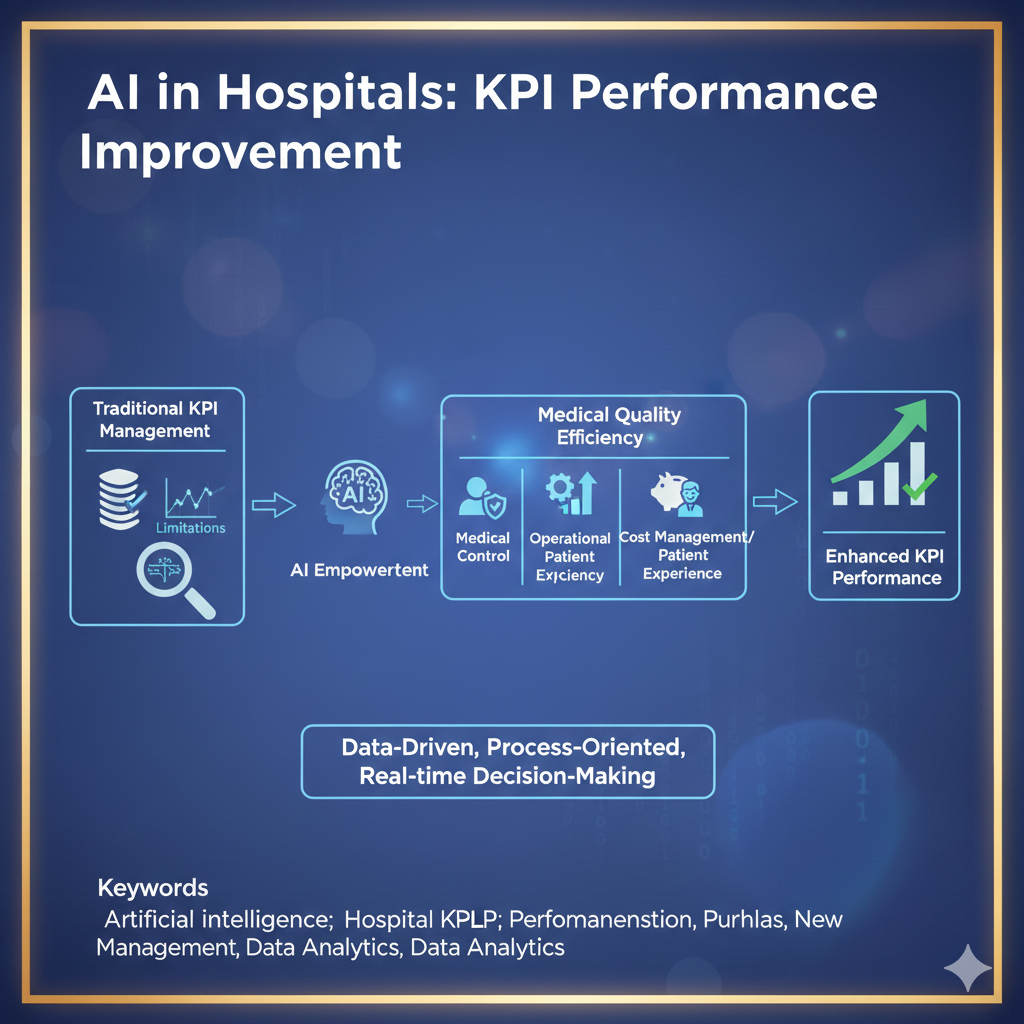
In the context of high-quality development in public hospitals, Key Performance Indicators (KPI) have become an important management tool for hospital managers to enhance medical quality, operational efficiency, and service levels. However, traditional hospital KPI management exhibits significant shortcomings in data integration, dynamic monitoring, and decision support, struggling to meet the demands of refined management. This study aims to systematically analyze the mechanism through which Artificial Intelligence (AI) enhances hospital KPI performance from the perspective of hospital managers, construct an analytical framework for AI-empowered hospital KPI management, and explore its implementation pathways in management practice. Employing a normative research method, this paper summarizes the limitations of traditional hospital KPI management and synthesizes the empowering role of AI on KPI performance across aspects such as medical quality control, operational efficiency improvement, cost management, and patient experience optimization. The results indicate that by enhancing the real-time and prospective nature of data analysis, AI contributes to transforming hospital KPI management from outcome-oriented to process-oriented, and from experience-driven to data-driven. The study posits that systematically integrating AI into the hospital performance management system helps increase the scientific rigor and sustainability of managerial decision-making, providing crucial support for the high-quality development of hospitals. This research offers theoretical reference and managerial insights for hospital managers advancing the practice of AI-empowered performance management.
References
Ahmed, A., Xi, R., Hou, M., Shah, S. A., & Hameed, S. (2023). Harnessing Big Data Analytics for Healthcare: A Comprehensive Review of Frameworks, Implications, Applications, and Impacts. IEEE Access, 11, 112891-112928.https://doi.org/10.1109/ACCESS.2023.3323574
Almehwari, S., Almalki, I., Abumilha, B., & Altharwi, B. (2024). Improving Hospital Efficiency and Cost Management: A Systematic Review and Meta-Analysis. Cureus, 16(10),e71721.https://doi.org/10.7759/cureus.71721
Amer, F., Hammoud, S., Khatatbeh, H., Lohner, S., Boncz, I., & Endrei, D. (2022). A systematic review: the dimensions to evaluate health care performance and an implication during the pandemic. BMC Health Services Research, 22(1), 621. https://doi.org/10.1186/s12913-022-07863-0
Amos, D. (2022). A practical framework for performance measurement of facilities management services in developing countries’ public hospitals. Journal of Facilities Management, 20(5), 713-731. https://doi.org/10.1108/JFM-03-2021-0034
Askin, S., Burkhalter, D., Calado, G., & El Dakrouni, S. (2023). Artificial Intelligence Applied to clinical trials: opportunities and challenges. Health and Technology, 13(2), 203-213. https://doi.org/10.1007/s12553-023-00738-2
Bemgal, S., & Haggerty, N. (2025). Generative mechanisms of IT-enabled transformation of a hospital laboratory: A critical realist evaluation. The journal of strategic information systems, 34(3), 101923. https://doi.org/10.1016/j.jsis.2025.101923
Chen, J. K., & Ho, H.-H. (2023). Asset resource optimization solution for smart hospital facilities and energy management through an interpretive structural model. Buildings, 13(12), 3064. https://doi.org/10.3390/buildings13123064
Cosa, M., & Torelli, R. (2024). Digital Transformation and Flexible Performance Management: A Systematic Literature Review of the Evolution of Performance Measurement Systems. Global Journal of Flexible Systems Management, 25(3), 445-466. https://doi.org/10.1007/s40171-024-00409-9
Fallahnezhad, M., Langarizadeh, M., & Vahabzadeh, A. (2024). Key performance indicators of hospital supply chain: a systematic review. BMC Health Services Research, 24(1), 1610. https://doi.org/10.1186/s12913-024-11954-5
Fatema, N., Malik, H., & Ahmad, W. (2021). Data driven intelligent model for quality management in healthcare. Journal of Intelligent & Fuzzy Systems, 42(2), 1155-1169.https://doi.org/10.3233/JIFS-189779
Gao, X., He, P., Zhou, Y., & Qin, X. (2024). Artificial intelligence applications in smart healthcare: a survey. Future Internet, 16(9), 308.https://doi.org/10.3390/fi16090308
Hadian, S. A., Rezayatmand, R., Shaarbafchizadeh, N., Ketabi, S., & Pourghaderi, A. R. (2024). Hospital performance evaluation indicators: a scoping review. BMC Health Services Research, 24(1), 561. https://doi.org/10.1186/s12913-024-10940-1
Hogg, H. D. J., Al-Zubaidy, M., Group, T. E. M. S. S. R., Talks, J., Denniston, A. K., Kelly, C. J., Malawana, J., Papoutsi, C., Teare, M. D., & Keane, P. A. (2023). Stakeholder perspectives of clinical artificial intelligence implementation: systematic review of qualitative evidence. Journal of Medical Internet Research, 25, e39742. https://doi.org/10.2196/39742
Kaplan, R. S. (2009). Conceptual Foundations of the Balanced Scorecard. Handbooks of management accounting research, 3, 1253-1269. https://doi.org/10.1016/S1751-3243(07)03003-9
Karampotsis, E., Aspridis, G. M., Dounias, G., & Exarchou, V. (2024). Critical success factors and key performance indicators in the modernization of public services: empirical evidence from Greece. International Review of Public Administration, 29(4), 330-352. https://doi.org/10.1080/12294659.2024.2415169
Li, J., Tian, Y., & Zhou, T. (2024). Public Health Information Systems. Healthcare Information Systems: Progress, Challenges and Future Directions, 8, 207-247.https://doi.org/10.1007/978-981-97-9551-2_8
Liu, W., Chan, A. P., Chan, M. W., Darko, A., & Oppong, G. D. (2025). Key performance indicators for hospital planning and construction: a systematic review and meta-analysis. Engineering, Construction and Architectural Management, 32(5), 3375-3406. https://doi.org/10.1108/ECAM-10-2023-1060
Maleki Varnosfaderani, S., & Forouzanfar, M. (2024). The Role of AI in Hospitals and Clinics: Transforming Healthcare in the 21st Century. Bioengineering (Basel), 11(4),38. https://doi.org/10.3390/bioengineering11040337
Pietronudo, M. C., Zhou, F., Caporuscio, A., La Ragione, G., & Risitano, M. (2022). New emerging capabilities for managing data-driven innovation in healthcare: the role of digital platforms. European Journal of Innovation Management, 25(6), 867-891.https://doi.org/10.1108/EJIM-07-2021-0327