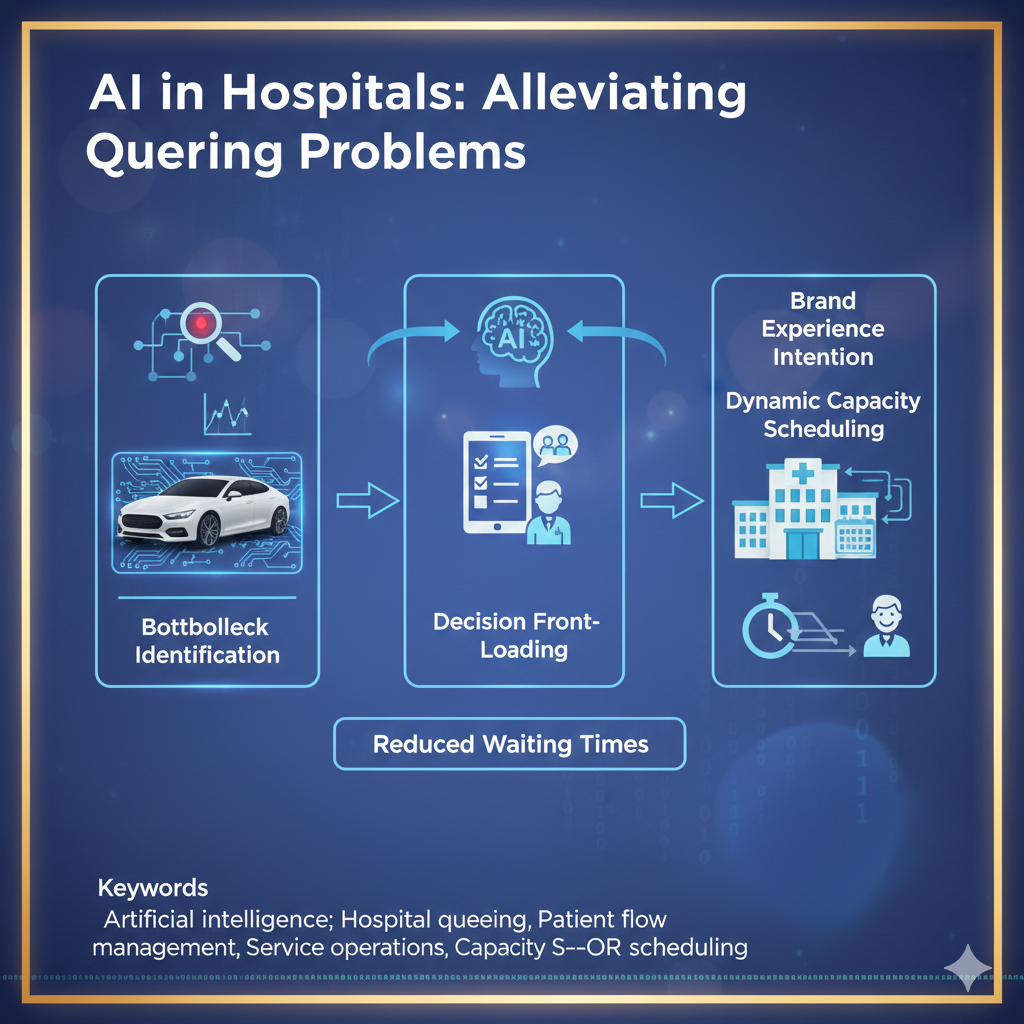
The Role of Artificial Intelligence in Alleviating Hospital Queuing Problems and Its Specific Manifestations
Keywords:
Artificial intelligence, Hospital queuing, Patient flow management, Service operations, Capacity schedulingAbstract
With the continuous growth in healthcare service demand, hospital queuing problems have become increasingly prominent and have emerged as a critical factor affecting both the operational efficiency of healthcare systems and patients’ care experiences. Traditional approaches that primarily rely on increasing human resources often fail to fundamentally alleviate queuing phenomena in complex healthcare systems. From the perspectives of service operations and patient flow management, this study explores the role of artificial intelligence (AI) in mitigating hospital queuing problems and examines its specific manifestations. Using a scenario analysis approach, this study takes the outpatient process of a general hospital as a representative research context and analyzes AI interventions from three dimensions: bottleneck identification, decision front-loading, and dynamic capacity scheduling. The findings indicate that by integrating multi-source healthcare data and conducting predictive analytics, AI can systematically alleviate queuing problems and reduce patient waiting times without relying solely on workforce expansion. The results provide managerial insights into the application of AI in hospital queuing management.
References
Ala, A., Yazdani, M., Ahmadi, M., Poorianasab, A., & Attari, M. Y. N. (2023). An efficient healthcare chain design for resolving the patient scheduling problem: queuing theory and MILP-ASA optimization approach. Annals of Operations Research, 328(1), 3-33. https://doi.org/10.1007/s10479-023-05287-5
Alves, M., Seringa, J., Silvestre, T., & Magalhães, T. (2024). Use of Artificial Intelligence tools in supporting decision-making in hospital management. BMC Health Services Research, 24(1), 1282.https://doi.org/10.1186/s12913-024-11602-y
Anshari, M., Hamdan, M., Ahmad, N., & Ali, E. (2025). Public service delivery, artificial intelligence and the sustainable development goals: trends, evidence and complexities. Journal of Science and Technology Policy Management, 16(1), 163-181. https://doi.org/10.1108/JSTPM-07-2023-0123
Barros, O., Weber, R., & Reveco, C. (2021). Demand analysis and capacity management for hospital emergencies using advanced forecasting models and stochastic simulation. Operations Research Perspectives, 8, 100208.https://doi.org/10.1016/j.orp.2021.100208
Beheshtinia, M. A., Fathi, M., Ghobakhloo, M., & Mubarak, M. F. (2025). Enhancing Hospital Services: Achieving High Quality Under Resource Constraints. Health Services Insights, 18, 11786329251331311.https://doi.org/10.1177/11786329251331311
Elahi, M., Afolaranmi, S. O., Martinez Lastra, J. L., & Perez Garcia, J. A. (2023). A comprehensive literature review of the applications of AI techniques through the lifecycle of industrial equipment. Discover Artificial Intelligence, 3(1), 43. https://doi.org/10.1007/s44163-023-00089-x
Elalouf, A., & Wachtel, G. (2022). Queueing Problems in Emergency Departments: A Review of Practical Approaches and Research Methodologies. In Operations Research Forum, 3(1),021-00114.https://doi.org/10.1007/s43069-021-00114-8
Huang, H., Huang, X., Zhang, Z., Chen, H., Wei, W., & Lu, W. (2025). Implementing system dynamics in hospital services to improve operational efficiency: An empirical research study. Health Research Policy and Systems, 23(1), 134. https://doi.org/10.1186/s12961-025-01394-w
Jones, C. H., & Dolsten, M. (2024). Healthcare on the brink: navigating the challenges of an aging society in the United States. npj Aging, 10(1), 22. https://doi.org/10.1038/s41514-024-00148-2
Khalifa, M., & Albadawy, M. (2024). AI in diagnostic imaging: Revolutionising accuracy and efficiency. Computer Methods and Programs in Biomedicine Update, 5, 100146. https://doi.org/10.1016/j.cmpbup.2024.100146
Knight, D. R. T., Aakre, C. A., Anstine, C. V., Munipalli, B., Biazar, P., Mitri, G., Valery, J. R., Brigham, T., Niazi, S. K., Perlman, A. I., Halamka, J. D., & Dabrh, A. M. A. (2023). Artificial intelligence for patient scheduling in the real-world health care setting: A metanarrative review. Health Policy and Technology, 12(4), 100824.https://doi.org/https://doi.org/10.1016/j.hlpt.2023.100824
Li, L., Diouf, F., & Gorkhali, A. (2022). Managing outpatient flow via an artificial intelligence enabled solution. Systems Research and Behavioral Science, 39(3), 415-427.https://doi.org/10.1002/sres.2870
Maleki Varnosfaderani, S., & Forouzanfar, M. (2024). The Role of AI in Hospitals and Clinics: Transforming Healthcare in the 21st Century. Bioengineering (Basel), 11(4). https://doi.org/10.3390/bioengineering11040337
Marshall, E. G., Miller, L., & Moritz, L. R. (2023). Challenges and impacts from wait times for specialist care identified by primary care providers: Results from the MAAP study cross-sectional survey. Healthc Manage Forum, 36(5), 340-346. https://doi.org/10.1177/08404704231182671
Morales, J., Silva-Aravena, F., & Saez, P. (2024). Reducing waiting times to improve patient satisfaction: a hybrid strategy for decision support management. Mathematics, 12(23), 3743. https://doi.org/10.3390/math12233743
Nguyen, Q., Wybrow, M., Burstein, F., Taylor, D., & Enticott, J. (2022). Understanding the impacts of health information systems on patient flow management: A systematic review across several decades of research. Plos One, 17(9), e0274493. https://doi.org/10.1371/journal.pone.0274493
Samadbeik, M., Staib, A., Boyle, J., Khanna, S., Bosley, E., Bodnar, D., Lind, J., Austin, J. A., Tanner, S., Meshkat, Y., de Courten, B., & Sullivan, C. (2024). Patient flow in emergency departments: a comprehensive umbrella review of solutions and challenges across the health system. BMC Health Services Research, 24(1), 274. https://doi.org/10.1186/s12913-024-10725-6
Tello, M., Reich, E. S., Puckey, J., Maff, R., Garcia-Arce, A., Bhattacharya, B. S., & Feijoo, F. (2022). Machine learning based forecast for the prediction of inpatient bed demand. BMC Medical Informatics and Decision Making, 22(1), 55. https://doi.org/10.1186/s12911-022-01787-9
Tiso, A., Pozzan, C., & Verbano, C. (2022). Health lean management implementation in local health networks: A systematic literature review. Operations Research Perspectives, 9, 100256. https://doi.org/10.1016/j.orp.2022.100256
Tyagi, M., Tyagi, P. K., Singh, S., Sathpathy, S., Kant, S., Gupta, S. K., & Singh, R. (2023). Impact of application of queuing theory on operational efficiency of patient registration. Medical Journal Armed Forces India, 79(3), 300-308. https://doi.org/10.1016/j.mjafi.2021.06.028
Walters, J. K., Sharma, A., Malica, E., & Harrison, R. (2022). Supporting efficiency improvement in public health systems: a rapid evidence synthesis. BMC Health Services Research, 22(1), 293. https://doi.org/10.1186/s12913-022-07694-z