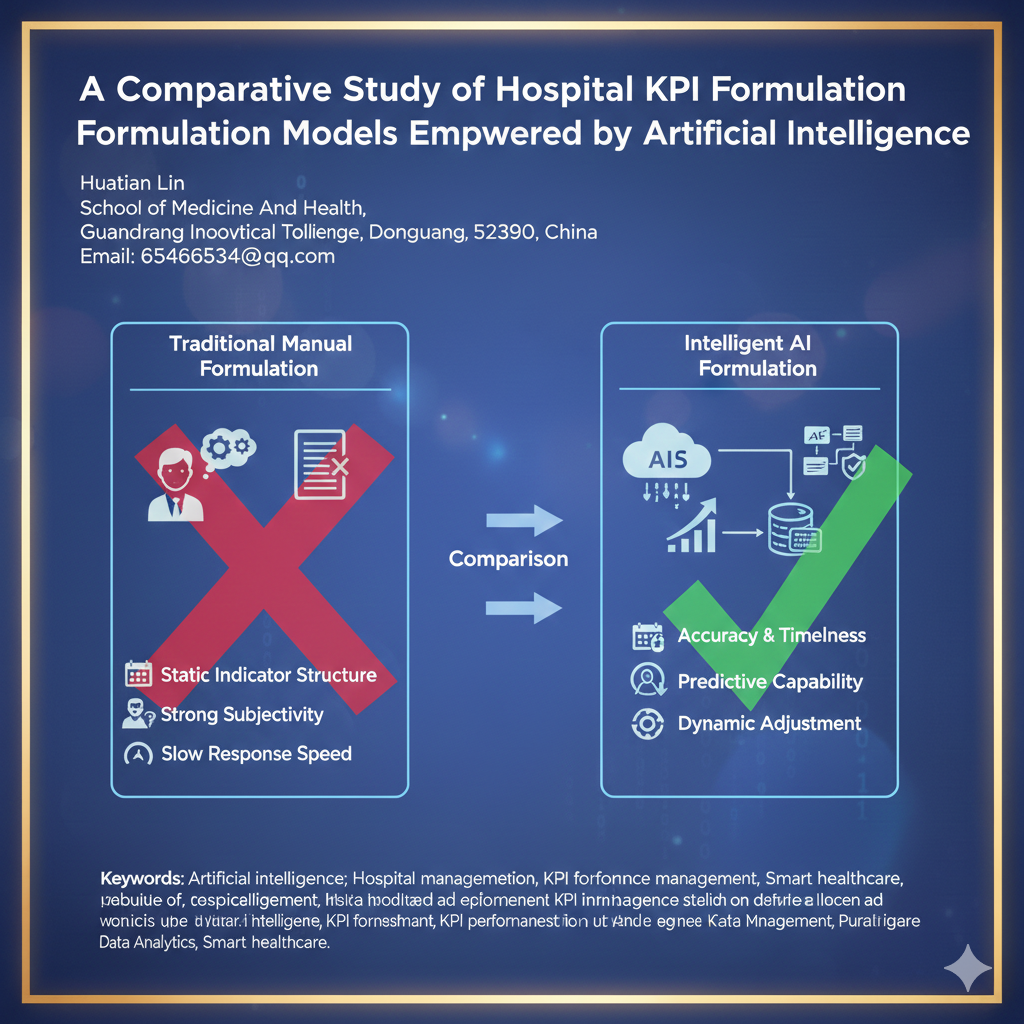
A Comparative Study of Hospital KPI Formulation Models Empowered by Artificial Intelligence
An Analysis Based on Traditional Manual Formulation and Intelligent Formulation Paths
Keywords:
Artificial intelligence, Hospital management, KPI formulation, Performance management, Smart healthcareAbstract
Hospital Key Performance Indicators (KPIs) are important management tools that connect strategic objectives with operational execution. Traditional hospital KPI formulation mainly relies on managerial experience and historical statistical data, which in practice suffers from problems such as static indicator structures, strong subjectivity, and slow response speed. With the widespread application of artificial intelligence technologies in healthcare management, intelligent KPI formulation methods based on big data analytics and machine learning models have gradually become a new development direction. This study takes traditional manual KPI formulation and AI-assisted KPI formulation as research objects. Through literature analysis and case comparison, the differences between the two models are systematically compared from the perspectives of formulation logic, data sources, dynamic adjustment capability, and management effectiveness. The results indicate that AI-driven KPI formulation models demonstrate significant advantages in accuracy, timeliness, and predictive capability, while still facing certain challenges in data governance and organizational adaptation.
References
Adawiyah, A. (2024). Unraveling the Dynamics of Performance Measurement: A Qualitative Study on Adopting Continuous and Datadriven Approaches in Performance Management. Golden Ratio of Human Resource Management, 4(1), 30-41.https://doi.org/10.52970/grhrm.v4i1.407
Al-Dmour, R., Al-Dmour, H., Basheer Amin, E., & Al-Dmour, A. (2025). Impact of AI and big data analytics on healthcare outcomes: An empirical study in Jordanian healthcare institutions. Digital Health, 11, 20552076241311051. https://doi.org/10.1177/20552076241311051
Amos, D. (2022). A practical framework for performance measurement of facilities management services in developing countries’ public hospitals. Journal of Facilities Management, 20(5), 713-731. https://doi.org/10.1108/JFM-03-2021-0034
Arun Kumar Reddy, A. (2025). AI Tools for Data Performance Enhancement: A Comprehensive Review. Journal of Computer Science and Technology Studies, 7(6), 639-648. https://doi.org/10.32996/jcsts.2025.7.74
Chen, P., Wu, L., & Wang, L. (2023). AI fairness in data management and analytics: A review on challenges, methodologies and applications. Applied Sciences, 13(18), 10258. https://doi.org/10.3390/app131810258
El Arab, R. A., Abu-Mahfouz, M. S., Abuadas, F. H., Alzghoul, H., Almari, M., Ghannam, A., & Seweid, M. M. (2025). Bridging the Gap: From AI Success in Clinical Trials to Real-World Healthcare Implementation-A Narrative Review. Healthcare (Basel), 13(7), 701. https://doi.org/10.3390/healthcare13070701
Fallahnezhad, M., Langarizadeh, M., & Vahabzadeh, A. (2024). Key performance indicators of hospital supply chain: a systematic review. BMC Health Services Research, 24(1), 1610. https://doi.org/10.1186/s12913-024-11954-5
Fatema, N., Malik, H., & Ahmad, W. (2021). Data driven intelligent model for quality management in healthcare. Journal of Intelligent & Fuzzy Systems, 42(2), 1155-1169.https://doi.org/10.3233/JIFS-189779
Gomes, J., & Romão, M. (2025). Evaluating Maturity Models in Healthcare Information Systems: A Comprehensive Review. Healthcare (Basel), 13(15). https://doi.org/10.3390/healthcare13151847
Hadian, S. A., Rezayatmand, R., Shaarbafchizadeh, N., Ketabi, S., & Pourghaderi, A. R. (2024). Hospital performance evaluation indicators: a scoping review. BMC Health Services Research, 24(1), 561. https://doi.org/10.1186/s12913-024-10940-1
Hu, M., Chen, W., & Yip, W. (2022). Hospital management practices in county-level hospitals in rural China and international comparison. BMC Health Serv Res, 22(1), 64. https://doi.org/10.1186/s12913-021-07396-y
Kumar, R., Singh, A., Kassar, A. S. A., Humaida, M. I., Joshi, S., & Sharma, M. (2025). Adoption challenges to artificial intelligence literacy in public healthcare: an evidence based study in Saudi Arabia. Frontiers in Public Health, 13, 1558772. https://doi.org/10.3389/fpubh.2025.1558772
Li, L., Jiang, S., Yuan, J., Zhang, L., Xu, X., Wang, J., Zhou, Y., Li, Y., & Xu, J. (2025). From data silos to seamless integration and coordination: a data-asset centric approach to smart hospital facility management. Engineering, Construction and Architectural Management, 32(11), 7804-7831. https://doi.org/10.1108/ECAM-03-2024-0274
Li, P., Bastone, A., Mohamad, T. A., & Schiavone, F. (2023). How does artificial intelligence impact human resources performance. evidence from a healthcare institution in the United Arab Emirates. Journal of Innovation & Knowledge, 8(2), 100340. https://doi.org/10.1016/j.jik.2023.100340
Liu, W., Chan, A. P., Chan, M. W., Darko, A., & Oppong, G. D. (2025). Key performance indicators for hospital planning and construction: a systematic review and meta-analysis. Engineering, Construction and Architectural Management, 32(5), 3375-3406. https://doi.org/10.1108/ECAM-10-2023-1060
Maleki Varnosfaderani, S., & Forouzanfar, M. (2024). The Role of AI in Hospitals and Clinics: Transforming Healthcare in the 21st Century. Bioengineering (Basel), 11(4). https://doi.org/10.3390/bioengineering11040337
Maswadi, K., & Alhazmi, A. (2026). Towards Sustainable Health Management in the Kingdom of Saudi Arabia: The Role of Artificial Intelligence—A Systematic Review, Challenges, and Future Directions. Sustainability, 18(2), 905. https://doi.org/10.3390/su18020905
Tavares, M. C., & Vaz, M. (2025). Rethinking Performance Evaluation: Strategic Alignment in the Service Sector Through a Case-Based Framework. Administrative Sciences, 15(10), 390.https://doi.org/10.3390/admsci15100390
Wang, Y., Fu, W., Zhang, Y., Wang, D., Gu, Y., Wang, W., Xu, H., Ge, X., Ye, C., Fang, J., Su, L., Wang, J., He, W., Zhang, X., & Feng, R. (2024). Constructing and implementing a performance evaluation indicator set for artificial intelligence decision support systems in pediatric outpatient clinics: an observational study. Scientific Reports, 14(1), 14482. https://doi.org/10.1038/s41598-024-64893-w
Zamlynskyi, V., Kalinichenko, S., Kniazkova, V., Skrypnyk, N., & Avriata, A. (2025). 1 - Healthcare management using artificial intelligence. Revolutionizing Medical Systems using Artificial Intelligence,8,1-24.https://doi.org/10.1016/B978-0-443-32862-6.00001-8
Ziat, A., Sefiani, N., Azzouzi, H., & Reklaoui, K. (2024). A generic sustainable performance management system for hospital supply chain: design & analysis. Health Systems, 13(2), 97-108. https://doi.org/10.1080/20476965.2022.2155256