Research on AI-Embedded To-Be Processes and Modern Hospital Management
Keywords:
artificial intelligence, To-be process, smart hospital, modern management, performance managementAbstract
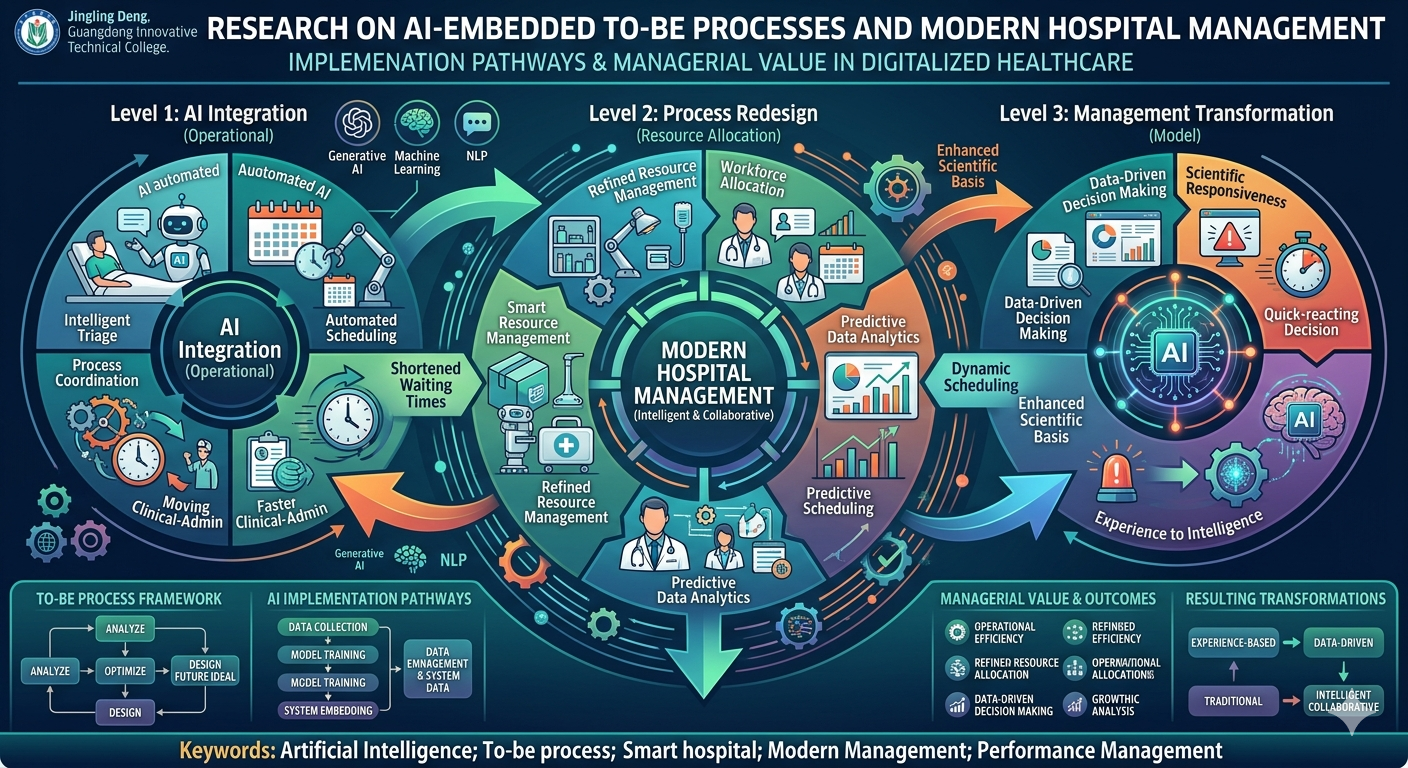
With the rapid development of artificial intelligence (AI) technologies, the healthcare industry is accelerating its transformation toward intelligent and digitalized systems. The To-be process, as an important tool for designing future ideal business models, provides a structural framework for the systematic application of AI in hospital management. This study focuses on the implementation pathways and managerial value of embedding AI into To-be processes, and analyzes its role in improving operational efficiency, optimizing resource allocation, and promoting the transformation of management models. The results indicate that AI integration into To-be processes produces significant effects at three levels. First, at the operational level, intelligent triage, automated scheduling, and process coordination mechanisms shorten patient waiting times and improve the efficiency of connections between clinical and administrative processes. Second, at the resource allocation level, data analytics and predictive models enable dynamic scheduling and refined management of medical resources, improving equipment utilization and workforce allocation. Third, at the management model level, AI facilitates the transformation of hospitals from experience-driven management to data-driven and intelligent decision-making management, enhancing the scientific basis and responsiveness of managerial decisions. Deep integration of AI into To-be processes helps promote the transition of hospital management from traditional experience-based approaches to data-driven and intelligent collaborative models.
References
Abdelwanis, M., Simsekler, M. C. E., Gabor, A. F., Sleptchenko, A., & Omar, M. (2026). Artificial intelligence adoption challenges from healthcare providers’ perspectives: A comprehensive review and future directions. Safety Science, 193, 107028. https://doi.org/10.1016/j.ssci.2025.107028
Ahmed Bayomy, N., A, E. K., & Abd-Elmegid, L. A. (2021). Adaptive model to support business process reengineering. PeerJ Comput Sci, 7, e505. https://doi.org/10.7717/peerj-cs.505
Alghareeb, E., & Aljehani, N. (2025). AI in Health Care Service Quality: Systematic Review. JMIR AI, 4(1), e69209. https://doi.org/10.2196/69209
Cao, G., Duan, Y., & Edwards, J. S. (2025). Organizational culture, digital transformation, and product innovation. Information & Management, 62(4), 104135. https://doi.org/10.1016/j.im.2025.104135
Chen, Y., Lehmann, C. U., & Malin, B. (2024). Digital Information Ecosystems in Modern Care Coordination and Patient Care Pathways and the Challenges and Opportunities for AI Solutions. J Med Internet Res, 26, e60258. https://doi.org/10.2196/60258
Davenport, T., & Kalakota, R. (2019). The potential for artificial intelligence in healthcare. Future Healthcare Journal, 6(2), 94-98. https://doi.org/10.7861/futurehosp.6-2-94
Elendu, C., Elendu, T. C., & Elendu, I. D. (2024). 5G-enabled smart hospitals: Innovations in patient care and facility management. Medicine, 103(20), e38239. https://doi.org/10.0000000000038329
Gao, Z., Qi, X., Zhang, X., Gao, X., He, X., Guo, S., & Li, P. (2022). Developing and Validating an Emergency Triage Model Using Machine Learning Algorithms with Medical Big Data. Risk Management and Healthcare Policy, 15, 1545-1551. https://doi.org/10.2147/RMHP.S355176
Grover, V., & Malhotra, M. K. (1997). Business process reengineering: A tutorial on the concept, evolution, method, technology and application. Journal of operations management, 15(3), 193-213.https://doi.org/10.1016/S0272-6963(96)00104-0
Jakovljevic, M., Timofeyev, Y., & Zhuravleva, T. (2024). The Impact of Pandemic-Driven Care Redesign on Hospital Efficiency. Risk Management and Healthcare Policy, 17, 1477-1491.https://doi.org/10.2147/RMHP.S465167
Khan, H. T. A., Addo, K. M., & Findlay, H. (2024). Public Health Challenges and Responses to the Growing Ageing Populations. Public Health Chall, 3(3), e213. https://doi.org/10.1002/puh2.213
Knight, D. R. T., Aakre, C. A., Anstine, C. V., Munipalli, B., Biazar, P., Mitri, G., Valery, J. R., Brigham, T., Niazi, S. K., Perlman, A. I., Halamka, J. D., & Dabrh, A. M. A. (2023). Artificial intelligence for patient scheduling in the real-world health care setting: A metanarrative review. Health Policy and Technology, 12(4), 100824.https://doi.org/10.1016/j.hlpt.2023.100824
Li, M., Jiang, Y., Zhang, Y., & Zhu, H. (2023). Medical image analysis using deep learning algorithms. Frontiers in Public Health, 11, 1273253.https://doi.org/10.3389/fpubh.2023.1273253
Maimaitiaili, M., Jiamaliding, Y., Dai, G., Xiao, H., Kuerbanjiang, W., & Yi, Y. (2025). Artificial Intelligence Platform Architecture for Hospital Systems: Systematic Review. Journal Medical Internet Research, 27, e79788. https://doi.org/10.2196/79788
Maleki Varnosfaderani, S., & Forouzanfar, M. (2024). The Role of AI in Hospitals and Clinics: Transforming Healthcare in the 21st Century. Bioengineering (Basel), 11(4), 377.https://doi.org/10.3390/bioengineering11040337
Mennella, C., Maniscalco, U., De Pietro, G., & Esposito, M. (2024). Ethical and regulatory challenges of AI technologies in healthcare: A narrative review. Heliyon, 10(4), e26297. https://doi.org/10.1016/j.heliyon.2024.e26297
Pradeep, M., Kumari, S., Tyagi, A. K., & Tiwari, S. (2024). Smart Hospital in Smart Cities. Digital Twin and Blockchain for Smart Cities, 579-603.https://doi.org/10.1002/9781394303564.ch24
Thacharodi, A., Singh, P., Meenatchi, R., Tawfeeq Ahmed, Z. H., Kumar, R. R. S., V, N., Kavish, S., Maqbool, M., & Hassan, S. (2024). Revolutionizing healthcare and medicine: The impact of modern technologies for a healthier future-A comprehensive review. Health Care Science, 3(5), 329-349. https://doi.org/10.1002/hcs2.115
Topol, E. J. (2019). High-performance medicine: the convergence of human and artificial intelligence. Nature Medicine, 25(1), 44-56. https://doi.org/10.1038/s41591-018-0300-7
Yu, D., Lin, H., Tan, X., Zhang, J., Liu, Z., Li, D., & Wang, Z. (2025). Feasibility of intelligent logistics management for operational efficiency in smart hospitals: a case study. Scientific Reports, 15(1), 36336. https://doi.org/10.1038/s41598-025-20227-y