From Experience to Intention: How Brand Experience Drives New Energy Vehicles (NEVs) Purchase Intention via Perceived Value and Brand Identification
Keywords:
Brand Experience; Perceived Value; Brand Identification; Purchase Intention; New Energy Vehicles; Xiaomi Auto; S–O–R FrameworkAbstract
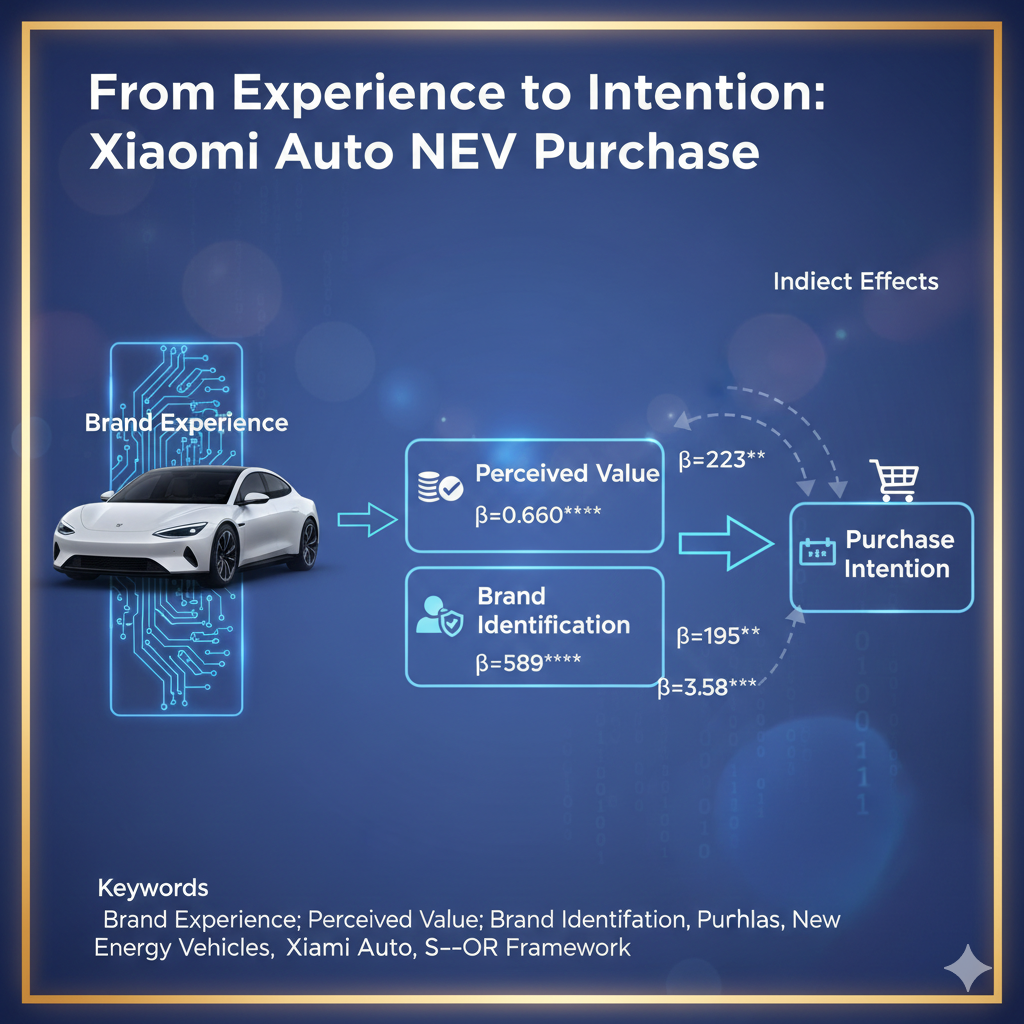
This study examines how brand experience influences consumers’ purchase intention toward new energy vehicles (NEVs) in the context of Xiaomi Auto, and tests the mediating roles of perceived value and brand identification. Survey data were collected from 396 adult potential NEV consumers in Chengdu, China using a combined online–offline approach, and analyzed via confirmatory factor analysis and structural equation modeling with bootstrapping. Results indicate that brand experience significantly increases perceived value (β = 0.660, p < .001) and brand identification (β = 0.589, p < .001). Both perceived value (β = 0.223, p = .002) and brand identification (β = 0.195, p = .003) positively predict purchase intention, while brand experience also retains a significant direct effect on purchase intention (β = 0.358, p < .001). Bootstrapping confirms two significant indirect effects via perceived value (β = 0.147, 95% CI [0.056, 0.259]) and brand identification (β = 0.115, 95% CI [0.043, 0.203]), indicating partial mediation. The findings highlight that experience-centered branding shapes NEV purchase intention through both value-based evaluation and identity-based connection, offering actionable guidance for ecosystem brands designing multi-touchpoint experiences to convert consumer attention into purchase intention.
References
Acar, A., Büyükdağ, N., Türten, B., Diker, E., & Çalışır, G. (2024). The role of brand identity, brand lifestyle congruence, and brand satisfaction on repurchase intention: a multi-group structural equation model. Humanities and Social Sciences Communications, 11(1), 1102. https://doi.org/10.1057/s41599-024-03618-w
Alyahya, M., Agag, G., Aliedan, M., & Abdelmoety, Z. H. (2023). Understanding the factors affecting consumers’ behaviour when purchasing refurbished products: A chaordic perspective. Journal of Retailing and Consumer Services, 75, 103492. https://doi.org/10.1016/j.jretconser.2023.103492
Baghel, D. (2023). The Role of Influencer Authenticity and Brand Trust in Shaping Consumer Behavior: Strategies to Engage Generation Z. ShodhKosh: Journal of Visual and Performing Arts, 4(1), 3327. https://doi.org/10.29121/shodhkosh.v4.i1.2023.3327
Blut, M., Chaney, D., Lunardo, R., Mencarelli, R., & Grewal, D. (2023). Customer Perceived Value: A Comprehensive Meta-analysis. Journal of Service Research, 27. https://doi.org/10.1177/10946705231222295
Castro-González, S., Bande, B., & Fernández-Ferrín, P. (2025). “I love your brand! I engage with you, and I do online brand-related activities (COBRAs)”: the role of brand value. European Journal of Management and Business Economics, 34(3), 359-383. https://doi.org/10.1108/EJMBE-10-2023-0331
Chen, S. (2025). Xiaomi Auto Marketing Strategy: SWOT and 4P Analysis. Advances in Economics, Management and Political Sciences, 245, 1-7. https://doi.org/10.54254/2754-1169/2025.BL29961
DelVecchio, D., Jones, W. J., & Baugh, L. (2024). From easy to known: How fluent brand processing fosters self‐brand connection. Psychology & Marketing, 41(4), 754-773. https://doi.org/10.1002/mar.21951
Gandhi, M., Ubba, S., & Jyoti. (2023). Effect of Consumer Value Perception on Consumer Purchase Intention: A Case of Private Label Apparels. Global Business Review, 09721509231166256. https://doi.org/10.1177/09721509231166256
Gaustad, T., & Warlop, L. Self-Brand Connections: Motivations, Origins, and Outcomes. In The Routledge Handbook of Identity and Consumption, 438-448. https://doi.org/10.4324/9781003383628-38
Harahap, M., Soemitra, A., & Rahma, T. (2024). Market Penetration Strategy by Increasing Firm Competitiveness. Golden Ratio of Marketing and Applied Psychology of Business, 5, 44-52. https://doi.org/10.52970/grmapb.v5i1.712
Hochreiter, V., Benedetto, C., & Loesch, M. (2023). The Stimulus-Organism-Response (S-O-R) Paradigm as a Guiding Principle in Environmental Psychology: Comparison of its Usage in Consumer Behavior and Organizational Culture and Leadership Theory. Journal of entrepreneurship and business development, 3, 7-16. https://doi.org/10.18775/jebd.31.5001
Hu, X., Yusof, R. N. R., & Mansor, Z. D. (2025). Consumers’ Purchase Intentions Towards New Energy Vehicles Based on the Theory of Planned Behaviour on Perceived Value: An Empirical Survey of China. World Electric Vehicle Journal, 16(3), 120. https://doi.org/10.3390/wevj16030120
Huang, W. (2025, August). Model Innovation on Corporate Performance in the Context of Digital Economy--the Case of Xiaomi Automobile. In 2025 5th International Conference on Enterprise Management and Economic Development (ICEMED 2025), 752-758. https://doi.org/10.2991/978-94-6463-811-0_79
Husain, R., Paul, J., & Koles, B. (2022). The role of brand experience, brand resonance and brand trust in luxury consumption. Journal of Retailing and Consumer Services, 66, 102895. https://doi.org/10.1016/j.jretconser.2021.102895
Irshad, O., Ahmad, S., & Mahmood, S. (2024). Fostering purchase intentions through CSR and service quality: the role of customer satisfaction, brand loyalty, and admiration. Sustainability, 16(23), 10584. https://doi.org/10.3390/su162310584
Jayadi, J., Putra, E., & Murwani, I. (2022). The Implementation of S-O-R Framework (Stimulus, Organism, and Response) in User Behavior Analysis of Instagram Shop Features on Purchase Intention. Scholars Journal of Engineering and Technology, 10, 42-53. https://doi.org/10.36347/sjet.2022.v10i04.003
Li, L. (2025). The Impact of the Low-Carbon Transition in the New Energy Vehicle Industry on the Ecological Environment and Economic Structure. MATEC Web of Conferences, 410. https://doi.org/10.1051/matecconf/202541002017
Li, M., & Chung, W. (2025). Enhancing brand experience and brand authenticity: The role of octomodal mental imagery and social presence. Plos one, 20(4), e0321883. https://doi.org/10.1371/journal.pone.0321883
Li, Z., Zhang, D., Zhang, Q., & Liu, X. (2023). Constructing online destination brand experience and bilateral behavioral intentions: a sensory conduction perspective. Current Issues in Tourism, 26(20), 3364-3380. https://doi.org/10.1080/13683500.2022.2122782
Lian, Y., Deeprasert, J., & Jiang, S. (2025). Cognitive–Affective Negotiation Process in Green Food Purchase Intention: A Qualitative Study Based on Grounded Theory. Foods, 14(16), 2856. https://doi.org/10.3390/foods14162856
Liu, W., & Xie, T. (2025). The Impact of New Energy Vehicle Industry Agglomeration on High-Quality Green Development—Evidence from China. World Electric Vehicle Journal, 16(7), 369. https://doi.org/10.3390/wevj16070369
Méndez-Lazarte, C., Galdo-Jiménez, A., Ghouleh-Grundl, A., Yance-Morales, X., & Bohorquez-Lopez, V. (2025). Virtual brand communities unveiled: A comprehensive bibliometric exploration. Digital Business, 5(2), 100122. https://doi.org/10.1016/j.digbus.2025.100122
Moorlock, E., Dekel-Dachs, O., Stokes, P., & Larsen, G. (2023). Constructing Consumer-Masstige brand relationships in a volatile social reality. Journal of Business Research, 155, 113381. https://doi.org/10.1016/j.jbusres.2022.113381
Muthaffar, A., Vilches-Montero, S., & Bravo-Olavarria, R. (2024). From digital touchpoints to digital journeys: How shopping mindsets influence appraisal of omnichannel journeys. International Journal of Information Management, 77, 102778. https://doi.org/10.1016/j.ijinfomgt.2024.102778
Na, M., Rong, L., Ali, M. H., Alam, S. S., Masukujjaman, M., & Ali, K. A. M. (2023). The Mediating Role of Brand Trust and Brand Love between Brand Experience and Loyalty: A Study on Smartphones in China. Behav Sci (Basel), 13(6). https://doi.org/10.3390/bs13060502
Pina, R., & Dias, Á. (2021). The influence of brand experiences on consumer-based brand equity. Journal of Brand Management, 28(2), 99-115. https://doi.org/10.1057/s41262-020-00215-5
Pine, B. J., & Gilmore, J. H. (2013). The experience economy: past, present and future. In Handbook on the experience economy, 21-44. https://doi.org/10.4337/9781781004227.00007
Rao, U., Ali, M., & Rubab, S. (2024). Unveiling the Power of Storytelling: A Comparative Analysis of Consumer vs. Brand Narratives in Shaping Favorable Attitude Toward Brands Through Emotions and Cognition. International Journal of Management Research and Emerging Sciences, 14. https://doi.org/10.56536/ijmres.v14i3.609
Rocklage, M. D., Berger, J., & Boghrati, R. (2025). The Trajectory of Confidence: Experience, Certainty, and Consumer Choice. Journal of Marketing Research, 00222437251372928. https://doi.org/10.1177/00222437251372928
Sang, V. M., & Cuong, M. C. (2025). The influence of brand experience on brand loyalty in the electronic commerce sector: the mediating effect of brand association and brand trust. Cogent Business & Management, 12(1), 2440629. https://doi.org/10.1080/23311975.2024.2440629
Tahir, A. H., Adnan, M., & Saeed, Z. (2024). The impact of brand image on customer satisfaction and brand loyalty: A systematic literature review. Heliyon, 10(16), e36254. https://doi.org/10.1016/j.heliyon.2024.e36254
Tang, Y., & Son, H. (2025). How Perceived Value Drives Usage Intention of AI Digital Human Advisors in Digital Finance. Systems, 13(11), 973. https://doi.org/10.3390/systems13110973
Tran, V.-D., & Nguyen, N. (2022). Investigating the relationship between brand experience, brand authenticity, brand equity, and customer satisfaction: Evidence from Vietnam. Cogent Business & Management, 9. https://doi.org/10.1080/23311975.2022.2084968
Wang, Y. (2025). Exploration of Xiaomi’s Automotive Marketing Strategy. Finance & Economics, 1(3). https://doi.org/10.61173/jzvv5035
Wang, Y., & Tian, Y. (2023). The Impact of New Energy Vehicle Product Attributes on Consumer Purchase Intention in the Backdrop of Sustainable Development Goals. Sustainability, 15, 1989. https://doi.org/10.3390/su15031989
Wei, S., Xu, H., Zheng, S., & Chen, J. (2024). Research on the Impact of New Energy Vehicle Companies’ Marketing Strategies on Consumers’ Purchase Intention. Sustainability, 16, 4119. https://doi.org/10.3390/su16104119
Zha, D., Foroudi, P., Jin, Z., & Melewar, T. (2022). Making sense of sensory brand experience: Constructing an integrative framework for future research. International Journal of Management Reviews, 24(1), 130-167. https://doi.org/10.1111/ijmr.12270
Zha, D., Foroudi, P., Melewar, T. C., & Jin, Z. (2025). Examining the Impact of Sensory Brand Experience on Brand Loyalty. Corporate Reputation Review, 28(1), 14-42. https://doi.org/10.1057/s41299-023-00175-x
Zhang, J., Islam, M. S., Jambulingam, M., Lim, W. M., & Kumar, S. (2024). Leveraging environmental corporate social responsibility to promote green purchases: The case of new energy vehicles in the era of sustainable development. Journal of Cleaner Production, 434, 139988. https://doi.org/10.3390/wevj16070369
Zhang, Z., & Liu, X. (2022). Consumers’ preference for brand prominence in the context of identity-based consumption for self versus for others: The role of self-construal. Journal of Global Scholars of Marketing Science, 32(4), 530-553. https://doi.org/10.1080/21639159.2021.2019600
Zhao, W., & Yi, L. (2023). Product innovation logic under the open innovation ecosystem: A case study of Xiaomi (China). Technology Analysis & Strategic Management, 35(6), 659-675. https://doi.org/10.1080/09537325.2021.1980208