Emotional Value Marketing Affecting Consumer Purchasing Behavior: Evidence from POP Mart
Keywords:
emotional value marketing, immersive experience, purchasing behavior, Pop Mart, experience economyAbstract
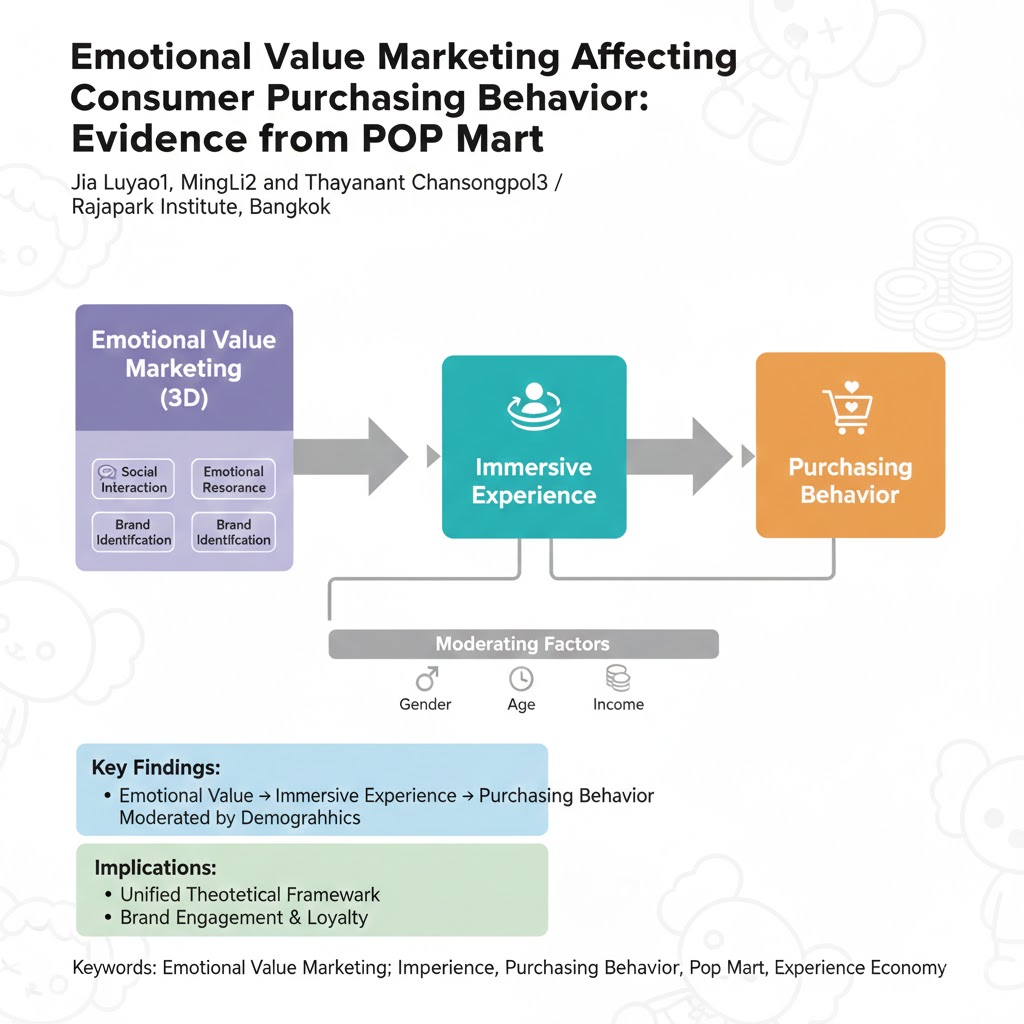
In the experience economy, consumer decisions are increasingly driven by emotions rather than by functional or price considerations. This study examines how emotional value marketing influences consumer purchasing behavior, using Pop Mart as a case study. Based on flow theory, emotional value theory, and the cognitive–affective system theory, the research develops a model linking three dimensions of emotional value—emotional resonance, social interaction, and brand identification—to purchasing behavior through the mediating role of immersive experience. A survey of 600 Pop Mart consumers across major Chinese cities was analyzed using regression and mediation tests. Results show that emotional value significantly enhance immersive experience, which in turn drives purchasing behavior. Gender, age, and income further moderate these relationships. The findings enrich emotional value marketing theory by integrating emotional value and immersive experience into a unified framework, while offering practical implications for cultural and creative brands aiming to strengthen emotional engagement and consumer loyalty.
References
Azad Moghddam, H., Carlson, J., Wyllie, J., & Mahmudur Rahman, S. (2024). Scroll, Stop, Shop: Decoding impulsive buying in social commerce. Journal of Business Research, 182, 114776. https://doi.org/10.1016/j.jbusres.2024.114776
Camacho, M. C., Deshpande, E., & Perino, M. T. (2026). The Cognitive–Affective Social Processing and Emotion Regulation (CASPER) model. Neuropsychopharmacology, 51(1), 136-152. https://doi.org/10.1038/s41386-025-02224-x
Cobb, J. A., & Gouda, M. G. (1997). Flow theory. IEEE/ACM transactions on networking, 5(5), 661-674. https://doi.org/10.1109/90.649567
Crespo, C. F., Ferreira, A. G., & Cardoso, R. M. (2023). The influence of storytelling on the consumer–brand relationship experience. Journal of Marketing Analytics, 11(1), 41-56. https://doi.org/10.1057/s41270-021-00149-0
Dinh, T. C. T., & Lee, Y. (2025). Going viral: How social and personal motivations drive emotional engagement and consumer online brand-related activities. Plos one, 20(11), e0336907. https://doi.org/10.1371/journal.pone.0336907
El-Adly, M. I., Souiden, N., & Khalid, A. (2024). The impact of emotional perceived value on hotel guests’ satisfaction, affective commitment and loyalty. Consumer Behavior in Tourism and Hospitality, 19(4), 551-567. https://doi.org/10.1108/CBTH-11-2023-0207
Gaustad, T., & Warlop, L. Self-Brand Connections: Motivations, Origins, and Outcomes. In The Routledge Handbook of Identity and Consumption, 438-448. https://doi.org/10.4324/9781003383628-38
Gokarna, P. (2021). Study of Customer Engagement through Emotional Branding. Shanlax International Journal of Management, 8, 11-20. https://doi.org/10.34293/management.v8i3.3455
Gunarian, N., Annabel, A., Desfianti, W., & Angelina, A. (2025). Exploring the Factors Behind Gen Z’s Blind Box Purchase Intention in Jakarta. Syntax Literate ; Jurnal Ilmiah Indonesia, 10. https://doi.org/10.36418/syntax-literate.v10i6.59923
Huang, Z., Zhu, Y., Hao, A., & Deng, J. (2022). How social presence influences consumer purchase intention in live video commerce: the mediating role of immersive experience and the moderating role of positive emotions. Journal of Research in Interactive Marketing, 17, 1-17. https://doi.org/10.1108/JRIM-01-2022-0009
Lee, C. T., & Hsieh, S. H. (2022). Can social media-based brand communities build brand relationships? Examining the effect of community engagement on brand love. Behaviour & Information Technology, 41(6), 1270-1285. https://doi.org/10.1080/0144929X.2021.1872704
Lou, L. (2025). Analysis of the Evolution of Blind Box Culture-Taking Pop Mart as an Example. Advances in Economics, Management and Political Sciences, 212, 116-119. https://doi.org/10.54254/2754-1169/2025.LD27552
Ma, L., Ou, W., & Sian Lee, C. (2022). Investigating consumers’ cognitive, emotional, and behavioral engagement in social media brand pages: A natural language processing approach. Electronic Commerce Research and Applications, 54, 101179. https://doi.org/10.1016/j.elerap.2022.101179
Morgan, C., & Townsend, C. (2022). Why the drive: The utilitarian and hedonic benefits of self-expression through consumption. Current Opinion in Psychology, 46, 101320. https://doi.org/10.1016/j.copsyc.2022.101320
Ngo, T. T. A., Nguyen, H. L. T., Mai, H. T. A., Nguyen, H. P., Mai, T. H. T., & Hoang, P. L. (2025). Analyzing the role of customers’ experiences and emotional responses in shaping Generation Z’s impulse buying behavior on Shopee video platform. Plos one, 20(5), e0322866. https://doi.org/10.1371/journal.pone.0322866
Özer, M. (2025). Emotional Brand Attachment with Masstige Brands: Revealing the Role of Consumption Values Across Fashion and Service Industries. Anadolu Üniversitesi İktisadi ve İdari Bilimler Fakültesi Dergisi, 26, 469-500. https://doi.org/10.53443/anadoluibfd.1672107
Shahid, S., Paul, J., Gilal, F. G., & Ansari, S. (2022). The role of sensory marketing and brand experience in building emotional attachment and brand loyalty in luxury retail stores. Psychology & Marketing, 39(7), 1398-1412. https://doi.org/10.1002/mar.21661
Sottolichio, A. J., Ponce, H. R., & Rojas Cabezas, G. (2025). Negative emotions’ impact on consumer satisfaction and loyalty due to failures in financial services: application of the affective-cognitive model. Academia Revista Latinoamericana de Administración, 38(1), 106-133. https://doi.org/10.1108/ARLA-04-2024-0056
Wang, Z., & Yang, X. (2025). How consumer value co-creation builds brand advocacy: the role of brand-self distance and brand familiarity. Marketing Intelligence & Planning, 1-16. https://doi.org/10.1108/MIP-01-2025-0046
Xuan Nguyen, T. D., & Nguyen, K. M. (2026). Demystifying how emotional and cognitive resonance to AI-driven content consistency sparks customer engagement and impulse buying in short-video E-commerce. Journal of Retailing and Consumer Services, 89, 104646. https://doi.org/10.1016/j.jretconser.2025.104646
Zahid, H., Ali, S., Danish, M., & Sulaiman, M. A. B. A. (2024). Factors affecting consumers intentions to purchase dairy products in Pakistan: A cognitive affective-attitude approach. Journal of international food & agribusiness marketing, 36(3), 347-372. https://doi.org/10.1080/08974438.2022.2125919