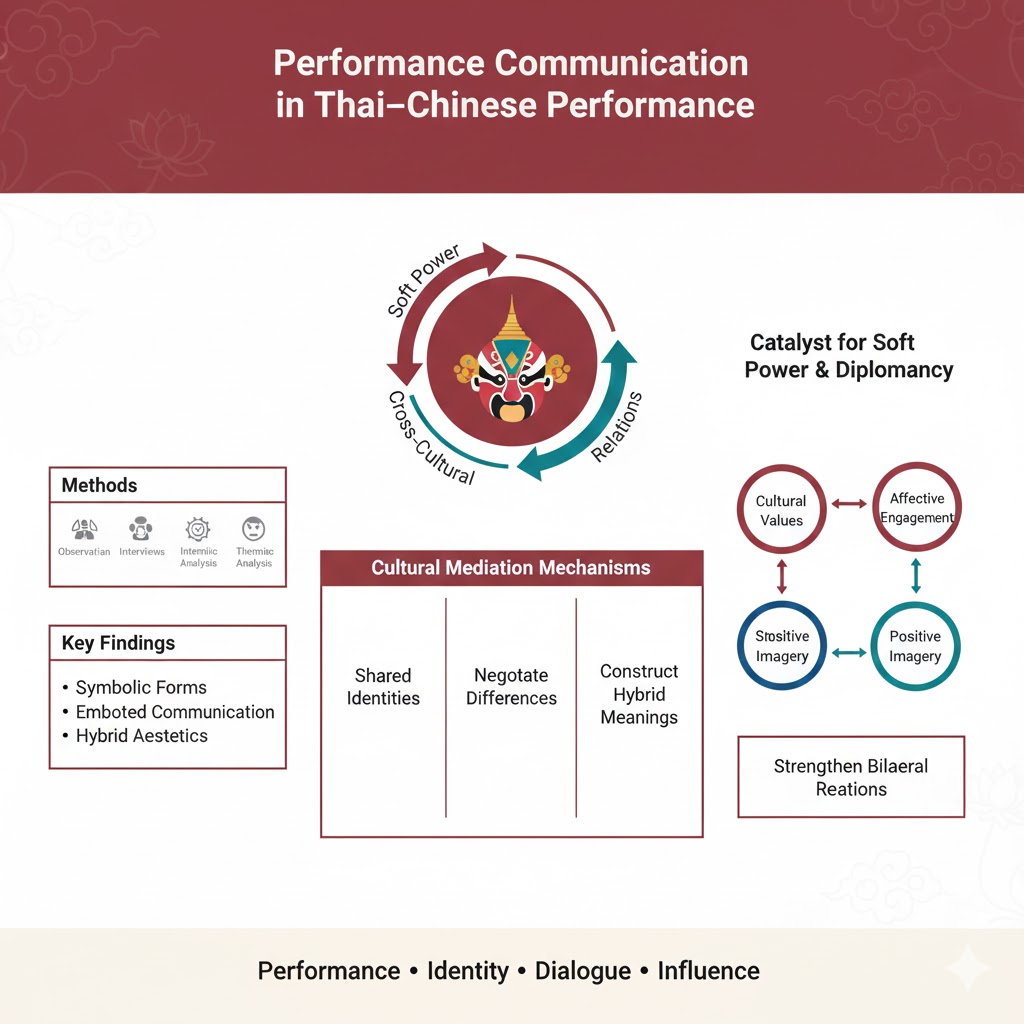
Performance Communication in Contemporary Thai–Chinese Performance: A Catalyst for Soft Power and Cross-Cultural Relations
Keywords:
Performance Communication, Contemporary Thai–Chinese Performance, Soft Power, Cross-Cultural RelationsAbstract
This study examines the role of performance communication in contemporary Thai–Chinese collaborative performance and its implications for soft power and cross-cultural relations. Drawing on qualitative methods—including performance observation, semi-structured interviews with directors and performers, and thematic analysis of multimedia performance materials—the research investigates how symbolic forms, embodied communication, and hybrid aesthetics function as cultural mediation mechanisms. The findings reveal that contemporary Thai–Chinese performances employ gesture, movement, musical fusion, scenography, and culturally embedded symbols to articulate shared identities, negotiate cultural differences, and construct hybrid cultural meanings. These communicative processes align with theoretical perspectives that conceptualize performance as both an expressive art form and a socio-cultural communication system. The study further demonstrates that Thai–Chinese performance serves as a catalyst for cultural soft power through three interrelated dimensions: the communication of cultural values, the generation of affective engagement, and the production of positive cultural imagery. These dynamics enhance cultural attractiveness and contribute to cultural diplomacy initiatives by strengthening bilateral relations and expanding platforms for intercultural dialogue. Additionally, the study identifies how performance communication bridges historical, diasporic, and contemporary narratives, enabling performers and audiences to co-construct intercultural understanding within an increasingly interconnected Asian context. Overall, this research advances theoretical insights into performance communication, intercultural performance, and hybrid cultural identity, while offering practical implications for cultural policy, creative diplomacy, and the development of intercultural performance platforms. The study underscores the potential of contemporary Thai–Chinese performance to function not only as cultural expression but also as an instrument for relational influence and soft power in the evolving landscape of Thai–Chinese socio-cultural relations.
References
Adoui, A. (2023). International Higher Education as a Soft Power Tool: Promoting Intercultural Understanding and Diplomacy in Foreign Policy. International Higher Education and The Rise of Soft Power as Cultural Diplomacy: A Comparative study of Morocco and South Korea, 51-80. https://doi.org/10.1007/978-3-031-44180-6_3
Baojie, J., & bakar, S. (2025). Exploring the Integration of Chinese Traditional Elements in Visual Communication and Its Influence on Cultural Identity and Public Perception: A review. Peta International Journal of Social Science and Humanity, 4, 1-28. https://doi.org/10.59088/pij.v4i3.79
Bhabha, H. K. (1994). The Location of Culture. Journal of Postcolonial Writing, 2(2), 163-177.
Busch, L., Malkin, A., & Belisle, J. (2025). Art in context: A multi-level analysis of art. Journal of Contextual Behavioral Science, 36, 100890. https://doi.org/10.1016/j.jcbs.2025.100890
Chambers, C. M. (2017). Performance Studies and Negative Epistemology. Performance Studies and Negative Epistemology: Performance Apophatics, 21-69. https://doi.org/10.1057/978-1-137-52044-9_2
Ding, S. (2025). Research on the Integration Path of Chinese Culture and Thai Native Culture under the Background of “Belt and Road Initiative”. The Development of Humanities and Social Sciences, 1, 0000087. https://doi.org/10.71204/0dp1s333
Dinu, E., Cocoșatu, M., Palăr, V., & Neamțu, F. (2025). Exploring the Role of Intercultural Communication and Cultural Intelligence in Enhancing Stakeholder Engagement and ESG Practices in International Organisations: Insights from the UN. Sustainability, 17(22), 10388. https://doi.org/10.3390/su172210388
Fang, J. (2023). Globalizing the sociology of the arts and culture: East Asian perspectives. The Journal of Chinese Sociology, 10(1), 8. https://doi.org/10.1186/s40711-023-00190-9
Grincheva, N. (2024). The past and future of cultural diplomacy. International Journal of Cultural Policy, 30(2), 172-191. https://doi.org/10.1080/10286632.2023.2183949
Homsombat, W., Wrasai, P., & Benjabutr, N. (2025). Measuring the impact of creative city attributes on regional economic development in Thailand. Asia-Pacific Journal of Regional Science, 9(2), 357-385. https://doi.org/10.1007/s41685-025-00374-w
Intason, M. (2026). Festival roles in fostering soft power: a case study of Bangkok, Thailand. International Journal of Event and Festival Management, 1-18. https://doi.org/10.1108/IJEFM-08-2025-0116
Isar, Y. R., & Triandafyllidou, A. (2021). Introduction to this Special Issue Cultural Diplomacy: What Role for Cities and Civil Society Actors? International Journal of Politics, Culture, and Society, 34(4), 393-402. https://doi.org/10.1007/s10767-020-09385-1
Jamil, H. (2025). Cultural Memory in the Art of Diaspora Communities. International Journal of Innovative Research, 3(01), 30-42. http://ijirjournal.com/
Juris, J. S. (2014). Embodying Protest: Culture and Performance within Social Movements. Conceptualizing Culture in Social Movement Research, 227-247. https://doi.org/10.1057/9781137385796_11
Kaplan, D. (2023). Performing Identity or Performing Relationships? Rethinking Performance Theory in Social Media Studies. Cultural Sociology, 18(4), 441-463. https://doi.org/10.1177/17499755221149184
Kasemsarn, K., Sawadsri, A., Kritsanaphan, A., & Nickpour, F. (2025). Urban Branding Through Cultural–Creative Tourism: A Review of Youth Engagement for Sustainable Development. Urban Science, 9(6), 204. https://doi.org/10.3390/urbansci9060204
Kim, Y. (2021). Introduction: Popular culture and soft power in the social media age. In The soft power of the Korean wave, 1-38.
Koad, P., & Dejpawuttikul, T. (2025). The pursuit of history of Thai Peranakan Chinese and their translocal identity in the Malay-Thai peninsula. Cogent Arts & Humanities, 12(1), 2582886. https://doi.org/10.1080/23311983.2025.2582886
Lim, W. M. (2024). What Is Qualitative Research? An Overview and Guidelines. Australasian Marketing Journal, 33(2), 199-229. https://doi.org/10.1177/14413582241264619
Liu, K. (2024). Cross-Cultural Communication Strategies of the Thai Advertising Industry and Their Implications for the International Communication of Chinese Advertising. Academic Journal of Management and Social Sciences, 9, 97-101. https://doi.org/10.54097/vqwah337
Liu, S., & Abdullah, N. (2023). The Impact of New Media on the Development of Chinese Theatre and Opera. Art and Society, 2, 11-14. https://doi.org/10.56397/AS.2023.10.02
Ma, J., & Kantasiri, K. (2024). A Study of Audience Perception and Artistic Integration of Chinese Opera in a Multicultural Society of Thailand. Journal of Roi Kaensarn Academi, 9(12), 252-266. https://so02.tci-thaijo.org/index.php/JRKSA/article/view/274692
Mandela, K. (2024). Influence of Cultural Differences on Global PR Campaigns. Journal of Public Relations, 3, 52-63. https://doi.org/10.47941/jpr.1775
McIntosh, D. M. D., & Eguchi, S. (2020). The Troubled Past, Present Disjuncture, and Possible Futures: Intercultural Performance Communication. Journal of Intercultural Communication Research, 49(5), 395-409. https://doi.org/10.1080/17475759.2020.1811996
Melis, A., & Pelle, M. (2025). Origins of Performance. Design for Performative Arts Spaces: Historical Evolution, Cultural Context, and Future Opportunities, 25-38. https://doi.org/10.1007/978-3-031-98215-6_3
Monfared, Z. R. (2024). Toward an Integrative Typology of Hybridity. Languacultural Hybridity and Translation, 87-122. https://doi.org/10.57088/978-3-7329-8825-9_3
Nye, J., & Power, S. (2004). The means to success in world politics. New York: Public Affairs, 193.
Panchal, P., & Mago, B. (2024). Social Media as a Tool for Cultural Preservation among Diaspora Communities. International Journal for Global Academic & Scientific Research, 3, 14-20. https://doi.org/10.55938/ijgasr.v3i3.79
Pandey, S., & Singh, K. (2024). Examining Semiotic Structures and Their Impact on Translation Equivalence in Media: A Cross-Cultural Analysis of India and the West. SMART MOVES JOURNAL IJELLH, 15-41. https://doi.org/10.24113/ijellh.v12i12.11516
Pun, B. L.-F., Ko, J., Fung, A. Y. H., & Leung, C. K. (2025). News, networks, and nostalgia: Examining the role of Hong Kong media and diaspora communities in identity preservation and integration. International Journal of Intercultural Relations, 108, 102254. https://doi.org/10.1016/j.ijintrel.2025.102254
Quayle, M. (2025). Social identity networks: People holding attitudes are a collective social identity information system and bipartite networks are a useful way to represent them. European review of social psychology, 1-66. https://doi.org/10.1080/10463283.2025.2514433
Saaida, M. (2023). The Role of Soft Power in Contemporary Diplomacy. International Journal of Research Publication and Reviews, 4, 3119-3130. https://doi.org/10.55248/gengpi.4.423.36302
Santos, N. d. A. e. S. F. d. (2024). The Interplay of Soft Power and Sharp Power in Sport Diplomacy: A Conceptual Framework. Journal of Global Sport Management, 9(4), 651-669. https://doi.org/10.1080/24704067.2021.1952092
Tian, L., & Wang, X. (2025). Cultural strategies and national expression in overseas dissemination of Chinese and Thai films. International Communication of Chinese Culture, 12(1), 131-147. https://doi.org/10.1007/s40636-024-00308-9
Wu, K. (2023). Cultural Confluence: The Impact of Traditional and Modern Synergies in Chinese Juvenile Musical Theater. International Journal of Education and Humanities, 11, 192-199. https://doi.org/10.54097/ijeh.v11i2.13825
Xia, S., & Cheng, W. (2023). Chinese Students’ Transcultural Strategies: Intentions to Navigate Identity Conflicts and Expand Their Identities Through Hong Kong Study Experiences. Journal of Comparative & International Higher Education, 15, 63-93. https://doi.org/10.32674/jcihe.v15i2.4535
Yuan, L., Khiatthong, T., & Addok, M. (2025). Integrating Thai and Chinese cultural symbols in contemporary painting: A cross-cultural artistic creation model. International Journal of Innovative Research and Scientific Studies, 8, 164-175. https://doi.org/10.53894/ijirss.v8i9.10645
Zheng, D., & Liu, Y. (2024). China–Thai Cultural Diplomacy Through the Buddhist Wat: A Case Study of the Thai Wat in Chaozhou Kaiyuan si, Guangdong. Religions, 15(11), 1365. https://doi.org/10.3390/rel15111365
Zheng, Y., Chen, G., Li, Z., & Hu, M. (2025). From Journey to Theatre: Unraveling the Influence of Traditional Chinese Opera’s Cultural Value on Tourists’ Behavioral Intentions. Sustainability, 17(4), 1544. https://doi.org/10.3390/su17041544