From Court Culture to River-and-Lake Culture: Jiang Kui's Literary and Artistic Creation and the "Third Way"
Abstract
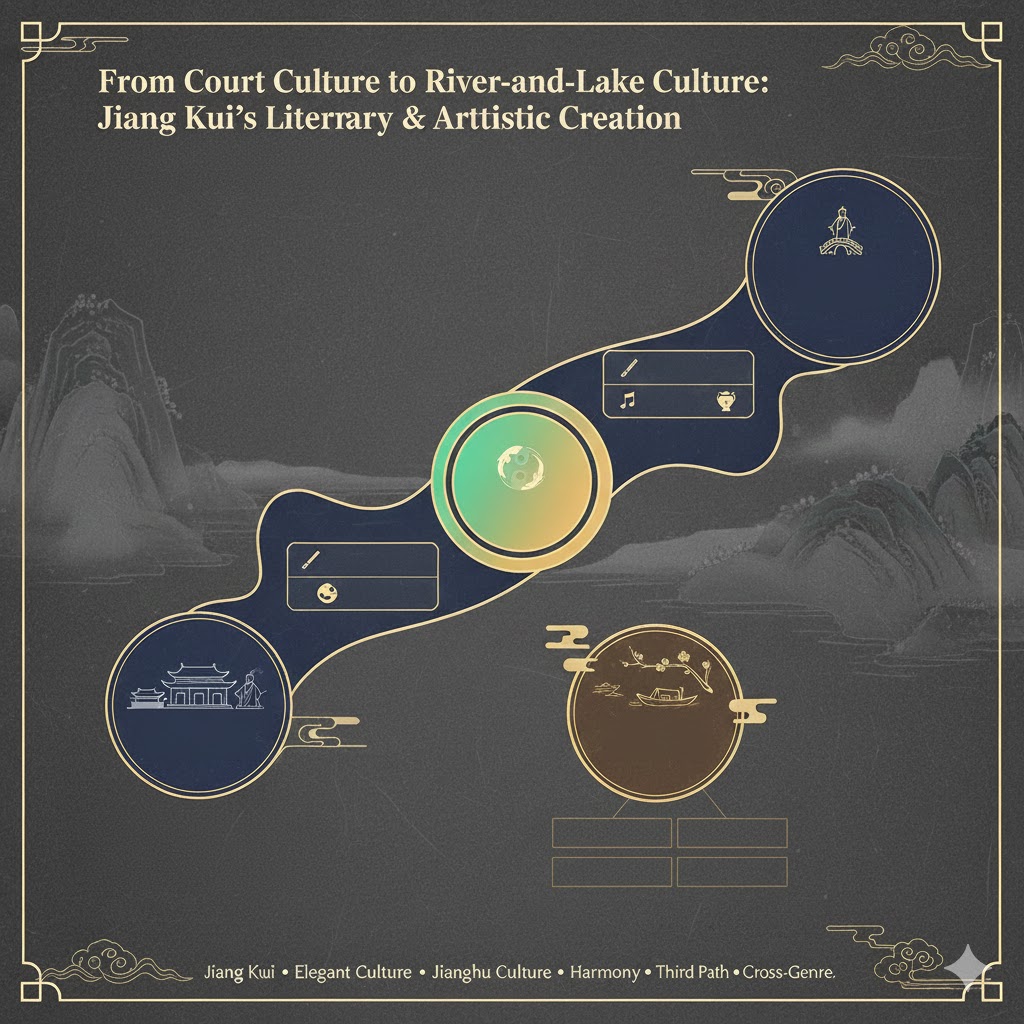
This study focuses on the central question: "How did Jiang Kui forge a third path between elegant culture and river-and-lake culture?" Methodologically, the article combines close textual reading, cultural reconstruction, and cross-genre analysis, incorporating Gadamer's "fusion of horizons" and Geertz's "thick description" to ensure analytical verifiability and historical contextual integrity. Findings reveal that Jiang Kui achieved a unified "elegant culture" system by crafting a high-toned aesthetics of "purity, simplicity, and quietude" through tonal restraint, transitional organization, and cool imagery clusters in lyrics and poetry. In his river-and-lake-inspired writings, he elevated individual wandering to shared spiritual capital via imagery chains like "temporary residence, solitary boat, cold plum blossoms, and clear night," establishing a paradigm of "poverty yet integrity, refusing to kowtow to contemporary fashions." Musically, he proposed the principle of "harmony" in On the Great Music, and through tonal juxtaposition, rhythmic pauses, and the blending of refined and popular styles in self-composed tunes like Nine Songs of Yue and Pity for the Red Robe, he constructed a "harmonious ideal" supported by both value and technical dimensions, ultimately pioneering a "third path" centered on art and ritual. The study's implications are threefold: first, Jiang Kui's cross-genre creativity deepens our understanding of Southern Song cultural tensions and literati identity formation; second, it provides a framework for future research—via digital corpora and quantitative methods to further reveal the coupling mechanisms of poetry-lyrics-music, and through comparative studies with contemporary and later literati to test the collective nature and historical continuity of the "third path"; third, it prompts reflection on how knowledge communities can maintain independent agency amid contradictions and respond to society from a contemporary perspective.
References
赵晓岚 (2001). 姜夔与南宋文化 [姜夔与南宋文化]. 长篇博士论文,华东师范大学文学博士论文。
阴法鲁 & 杨荫浏 (1957). 宋·姜白石创作歌曲研究 [宋·姜白石创作歌曲研究]. 北京: 人民音乐出版社.
张宏生 (1995). 江湖诗派研究 [江湖诗派研究]. 北京: 中华书局.
夏承燾 (1998). 姜白石词编年箋校 [姜白石词编年笺校]. 上海: 上海古籍出版社.
宗白华 (1996). 宗白华全集 [宗白华全集]. 合肥: 安徽教育出版社.
黄敏. (2018). 姜夔词用调研究 (硕士学位论文). 河北大学.
张红梅. (2006). 三种南宋传世乐谱的宫调研究 (硕士学位论文). 中央音乐学院.
郑祖襄. (1985). 姜白石歌曲研究. 北京: 人民音乐出版社.
陈东, & 曾美月. (2004). 姜白石歌曲十七首研究综述. 中国音乐, (3), 102-110.
李连生. (2000). 《白石道人歌曲》旁谱研究及词乐遗音初探. 音乐研究, (2), 45-58.
王安潮. (2012). 《玉树后庭花》的历史与形态. 浙江艺术职业学院学报, 10(2), 33-40.
刘新园. (2005). 《越九歌》的音乐学分析. 音乐艺术, 27(4), 55-67.
房日晰. (2010). 姜夔王沂孙词风之比较. 湖北大学学报(哲学社会科学版), 37(6), 88-94.
胡静, & 邓红梅. (2005). 试论姜夔词过片的结构功能. 南阳师范学院学报(社会科学版), 4(3), 56-60.
李倩. (2013). 姜夔诗歌中天气意象特征形成的原因. 牡丹江师范学院学报(哲学社会科学版), 42(5), 75-80.
伍晓蔓. (2016). 江西和江湖: 不同的意义场域——唐宋变革视野中的宋诗体派观察. 文学遗产, (2), 114-126.
张宏生. (1999). 偏离群体的别调——论方岳诗. 江海学刊, (6), 77-84.
许竹宜, & 郑定国. (2013). 梅花吐蕊绽幽香——南宋诗人方岳咏梅诗之探析. 汉学研究集刊, 31(1), 145-170.
吴树燊. (2008). 醉眼渺河洛遗恨夕阳中——论方岳词. 湖北经济学院学报(人文社会科学版), 5(4), 92-96.
王冉, & 巩本栋. (2021). 南宋复雅词集的编纂与文化绍兴. 清华大学学报(哲学社会科学版), 36(5), 19-29.
陈晓明. (2012). 美国解构主义在中国的传播与接受分析. 文艺理论与批评, 2012(6), 44–52.
伽达默尔. (2007). 诠释学Ⅰ:真理与方法——哲学诠释学的基本特征(洪汉鼎 译). 北京:商务印书馆.
格尔茨. (1999). 文化的解释(韩莉 译). 南京:译林出版社.
Gadamer, H.-G. (2004). Truth and method (J. Weinsheimer & D. G. Marshall, Trans., 2nd rev. ed.). London/New York: Continuum.
Geertz, C. (1973). The interpretation of cultures: Selected essays. New York: Basic Books.
王宁. (2015). 场外征用与文学的跨学科研究再识——答张江先生. 清华大学学报(哲学社会科学版), 30(2), 21–24+187.
郑祖襄. (1985). 姜白石歌曲研究. 中央音乐学院学报, 1985(4), 23–31.
李连生. (2000). 《白石道人歌曲》旁谱研究及词乐遗音初探. 音乐研究, (2), 45–58.
黄敏. (2018). 姜夔词用调研究述评. 河北北方学院学报(社会科学版), 34(1), 1–5.
胡静, & 邓红梅. (2005). 试论姜夔词过片的结构功能. 南阳师范学院学报(社会科学版), 2005(2), 80–84.
李倩. (2013). 姜夔诗歌中天气意象特征形成的原因. 牡丹江师范学院学报(哲学社会科学版), 2013(5), 75–80.
房日晰. (2015). 姜夔王沂孙词风之比较. 词学, (32), 43–55.
夏承焘. (1998). 姜白石词编年笺校. 上海: 上海古籍出版社.
宗白华. (1996). 宗白华全集. 合肥: 安徽教育出版社.
张宏生. (1994). 偏离群体的“别调”——论方岳诗. 江汉社会科学, (6), 77–84.
伍晓蔓. (2005). 宗黄学苏——论江西宗派的诗学选择. 文学遗产, (3), 118–131.
吴树燊. (2008). 试论方岳及其隐逸词. 重庆科技学院学报(社会科学版), (2), 66–70.
郑祖襄. (1985). 姜白石歌曲研究. 中央音乐学院学报, (4), 23–31.
张红梅. (2005). 姜夔《越九歌》的音乐学分析. 中国音乐学, (2), 45–53.
张红梅. (2005). 姜夔之《惜红衣》的译谱及音乐分析. 中国音乐学, (4), 60–68.
李连生. (2000). 《白石道人歌曲》旁谱研究及词乐遗音初探 (硕士学位论文). 河北大学.
李连生. (2003). 从《白石道人歌曲》旁谱论词乐与词律之关系. 江西社会科学, (6), 50–54.
陈东, & 曾美月. (2005). 姜白石歌曲十七首研究综述. 中国音乐, (3), 53–60.