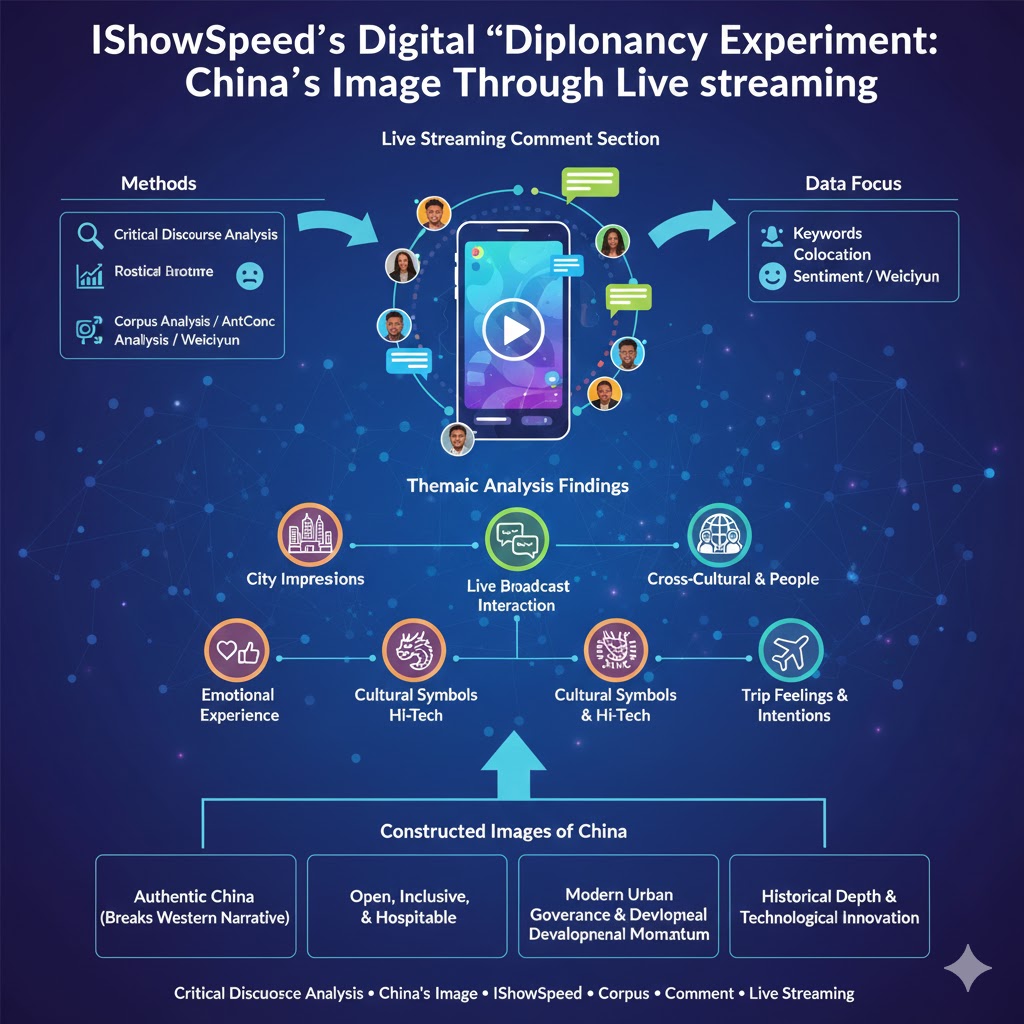
IShowSpeed’s Digital ‘Diplomacy Experiment’ Research on the Construction of China's Image through Live streaming Comment Discourse
Keywords:
Critical Discourse Analysis, China’s image, IShowSpeed, corpus, comment, live streamingAbstract
Previous studies on the construction of national image mostly relied on news reports,this study’s data was selected from the emerging live streaming industry. From the perspective of critical discourse analysis, it explored the construction of the Chinese national image in the live streaming comment section of IShowSpeed. The research employs AntConc 4.2.1 for contextual analysis and Weiciyun for sentiment analysis, focusing on the use of high-frequency keywords, collocation analysis, and sentiment analysis. The findings reveal that under the unfiltered live streaming, the discourse in the comment section focus on the following themes: City Impressions; Live Broadcast Interaction; Cross-Cultural Communication and Chinese People; Emotional Experience; Cultural Symbols and High-Technology; Feelings and Intentions Regarding the Trip. These themes collectively construct the following images of China: (1) A authentic China that breaks through the narrative framework of Western discourse; (2) A national image that combines openness, inclusiveness, and hospitality; (3) A national image that combines modernization of urban governance with strong developmental momentum; (4) A national image that integrates historical depth with technological innovation.
References
Ameyaw-Brobbey, T. (2023). China’s image-building in Africa: The intersection of the media and economic development investment in Mali. International Journal of Media & Cultural Politics, 19(2-3), 137-160. https://doi.org/10.1386/macp_00078_1
Ameyaw‐Brobbey, T. (2024). The media in China–Africa public relations: Assessing China's attractiveness beyond economic development assistance. Politics & Policy, 52(3), 551-572. https://doi.org/10.1111/polp.12596
Ato, R. A. (2025). Language and Power: A Critical Discourse Analysis of Political Speeches in English. Journal of Asian Multicultural Research for Social Sciences Study, 6(3), 67-82. https://doi.org/10.47616/jamrsss.v6i3.651
Chen, L., & Nizam, M. N. (2025). Research on China's national image construction from the perspective of cross-cultural communication. Journal of Sociology and Education, 1(1), 1-8. https://www.sci-open.net/index.php/JSE/article/view/365
Chen, X., & Jin, Y. (2022). Image construction: its connotations, types and discursive practices. Foreign Lang. Learn. Theory and Practice, 3, 1-12.
Chilton, P. (2004). Analysing political discourse: Theory and practice. routledge.
Fairclough, N. (2013). Language and power. Routledge.
Fotiadou, M. (2022). Corpus-Based Critical Discourse Analysis. The Language of Employability: A Corpus-Based Analysis of UK University Websites, 41-79. https://doi.org/10.1007/978-3-031-10252-3_3
Fu, Y. (2024). The Construction of China’s National Image under the COVID-19 Epidemic by the American News Media. International Journal of Education and Humanities, 15, 6-9. https://doi.org/10.54097/6fggxv24
Gries, S. (2021). A new approach to (key) keywords analysis: Using frequency, and now also dispersion. Research in Corpus Linguistics, 9, 1-33. https://doi.org/10.32714/ricl.09.02.02
Hellmann, O., & Oppermann, K. (2022). Photographs as Instruments of Public Diplomacy: China’s Visual Storytelling during the Covid-19 Pandemic. The Hague Journal of Diplomacy, 17(2), 177-215. https://doi.org/10.1163/1871191X-bja10097
Hidalgo Tenorio, E. (2011). Critical Discourse Analysis, An overview. NJES Nordic Journal of English Studies, 10. https://doi.org/10.35360/njes.247
Hou, Z. (2023). China’s Greater Bay Area Plan and Hong Kong: How Phraseologies Represent Different Voices in the Media. SAGE Open, 13(2), 21582440231178258. https://doi.org/10.1177/21582440231178258
Jin, Y. (2025). Media Representation and Social Identity: A Study of Public Discourse Construction and the Empowerment of Marginalised Groups in the Digital Age. International Journal of Education and Humanities, 19, 134-139. https://doi.org/10.54097/jq9t4b14
Khan, M. A., & Zaki, S. (2022). Corpus Assisted Critical Discourse Analysis of Pakistan’s Language Education Policy Documents: What are the Existing Language Ideologies? SAGE Open, 12(3), 21582440221121805. https://doi.org/10.1177/21582440221121805
Lehman-Ludwig, A., Burke, A., Ambler, D., & Schroeder, R. (2023). Chinese Anti-Westernism on social media. Global Media and China, 8(2), 119-137. https://doi.org/10.1177/20594364231166541
Li, Y. (2021). Does Chinese Foreign Aid Work in Sub-Saharan Africa? An Empirical Analysis. Chinese Political Science Review, 6. https://doi.org/10.1007/s41111-020-00170-1
Liu, D., & Zheng, J. (2023). Othering and Self-Cognition: A Paradigm for National Image Communication. Highlights in Art and Design, 3, 53-56. https://doi.org/10.54097/hiaad.v3i2.10115
Liu, Y., May, S., & Zhang, L. J. (2024). The ideological underpinnings in university English textbooks in China: A critical discourse analysis and corpus linguistics approach. Journal of Multilingual and Multicultural Development, 45(10), 4448-4467. https://doi.org/10.1080/01434632.2023.2173208
Ma, L., & Crosthwaite, P. (2026). Constructing China’s national image through political discourse: A corpus-based diachronic analysis of government work reports (2001–2025). Applied Corpus Linguistics, 6(1), 100179. https://doi.org/10.1016/j.acorp.2025.100179
Mei, Z. (2025). Research on Discourse System in China (1998–2023): A Bibliometric Analysis of Discourse System Research in China’s Philosophy and Social Sciences. SAGE Open, 15(2), 21582440251350431. https://doi.org/10.1177/21582440251350431
Müller, S., Brazys, S., & Dukalskis, A. (2024). Discourse wars and ‘mask diplomacy’: China’s global image management in times of crisis. Political Research Exchange, 6(1), 2337632. https://doi.org/10.1080/2474736X.2024.2337632
Norman, R., Hulme, R. C., Sarantopoulos, C., Chandran, V., Shen, H., Rodd, J. M., Joseph, H., & Taylor, J. S. H. (2023). Contextual diversity during word learning through reading benefits generalisation of learned meanings to new contexts. Quarterly Journal of Experimental Psychology, 76(7), 1658-1671. https://doi.org/10.1177/17470218221126976
Peng, Y., Wang, Y., Li, J., & Qiang, Y. (2024). Impact of AI-Oriented Live-Streaming E-Commerce Service Failures on Consumer Disengagement—Empirical Evidence from China. Journal of Theoretical and Applied Electronic Commerce Research, 19, 1580-1598. https://doi.org/10.3390/jtaer19020077
Qiao, M. (2025). Presentation of China’s National Image in Foreign News Media. Education, Language and Sociology Research, 6, p20. https://doi.org/10.22158/elsr.v6n3p20
Van Dijk, T. A. (1998). Ideology: A multidisciplinary approach.
Wei, R. (2022). A comparative ecological discourse analysis of China’s image in Chinese and foreign media. Mod Foreign Lang (Bimonthly), 45(3), 318-330. https://doi.org/10.1515/jwl-2023-1007
Wodak, R. (2004). Critical discourse analysis. Qualitative research practice, 185, 185-204. https://doi.org/10.1075/hoph.8.04wod
Xu, J., & Schneider, F. (2025). Influencers as emerging actors in global digital propaganda. European Journal of Cultural Studies, 13675494251351221. https://doi.org/10.1177/13675494251351221
Yang, S., Isa, S. M., & Ramayah, T. (2021). How Are Destination Image and Travel Intention Influenced by Misleading Media Coverage? Consequences of COVID-19 Outbreak in China. Vision, 26(1), 80-89. https://doi.org/10.1177/0972262921993245
Zhang, C., Afzaal, M., Omar, A., & Altohami, W. M. (2023). A corpus-based analysis of the stylistic features of Chinese and American diplomatic discourse. Frontiers in Psychology, 14, 1122675. https://doi.org/10.3389/fpsyg.2023.1122675
Zhu, Z., & Zhang, C. (2022). Analysis of the Relationship between National Image Building and International Communication Ability from the Perspective of Ecology under the Media Environment. J Environ Public Health, 2022, 9393446. https://doi.org/10.1155/2022/9393446