
Curriculum Needs Assessment to Enhance Professional Competency Development of Child Care Teachers at Child Development Centers under Local Government Organizations, Thailand
Article Sidebar
Main Article Content
Abstract
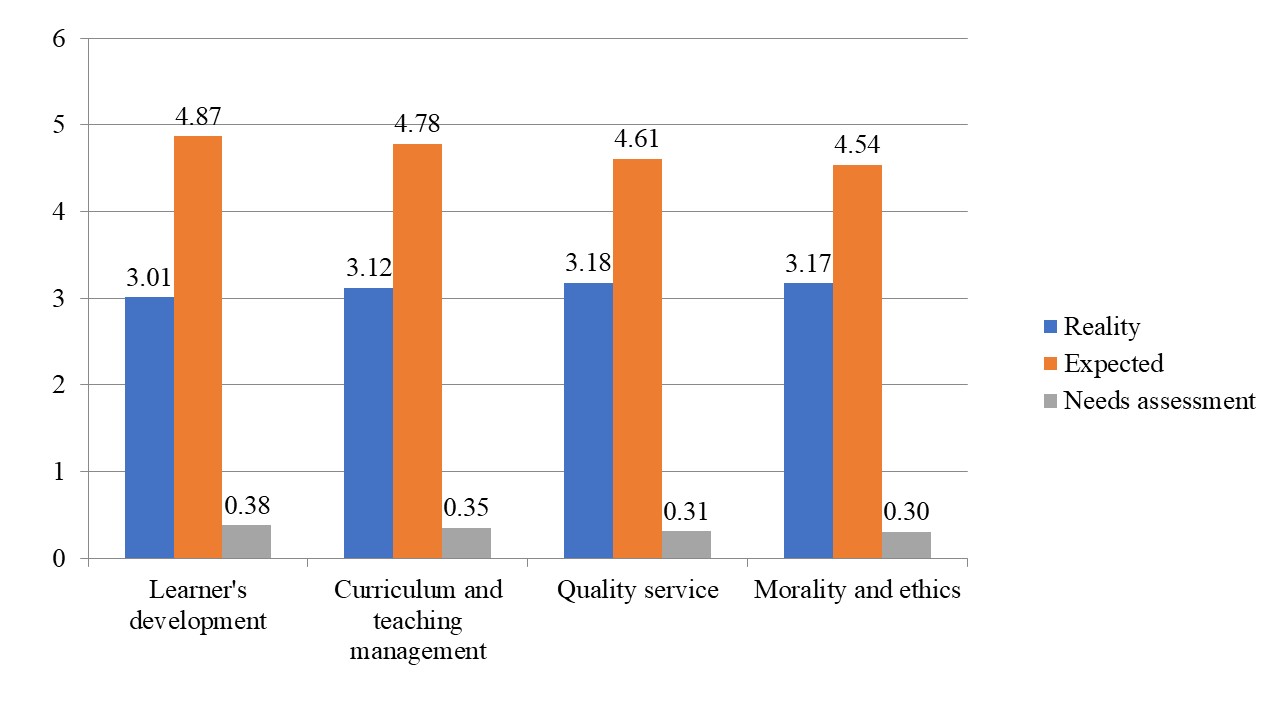
The research objectives were to study needs assessment, needs priority, and suggestions for professional competency development of child care teachers at child development centers under local government organizations. The study sample comprised 397 child care teachers. Research tools were a questionnaire and a focus group discussion guideline. Data analysis employed the techniques of frequency distribution, percentage, mean, standard deviation, paired-sample t-test, Modified Priority Needs Index, and content analysis. Research results are the following: 1) the means of the practice of professional competency development of child care teachers in real and expected conditions are different at .01 statistical significance in all dimensions -- indicating the needs of child care teachers for training in all dimensions of professional competency development; 2) needs priority for development in descending order are learner's development, curriculum and teaching management, quality service, and morality and ethics; 3) key suggestions for competency development are 3.1) teacher development enabling actual new learning process management techniques suitable for the 21st Century such as Web-Based Learning, Project-Based Learning, Student-Centered Learning, Self-Directed Learning, Collaborative Learning, and Problem-Based Learning; 3.2) development on learning and innovation skills suitable for 21st Century real life -- 4C's : creativity and innovation, critical thinking and problem solving, communication, and collaboration; and 3.3) development of curriculum and learning as (1) vision formulation oriented to 4C's, (2) community of collaboration building among stakeholders to feel ownership by shared vision design, (3) child development center system building for shared vision towards 4C's; (4) making 4C's as professional development framework, (5) injecting 4C's in curriculum and evaluation, (6) encouraging all teachers to instruct according to 4C's, and (7) building sustainable 4C's development culture.
